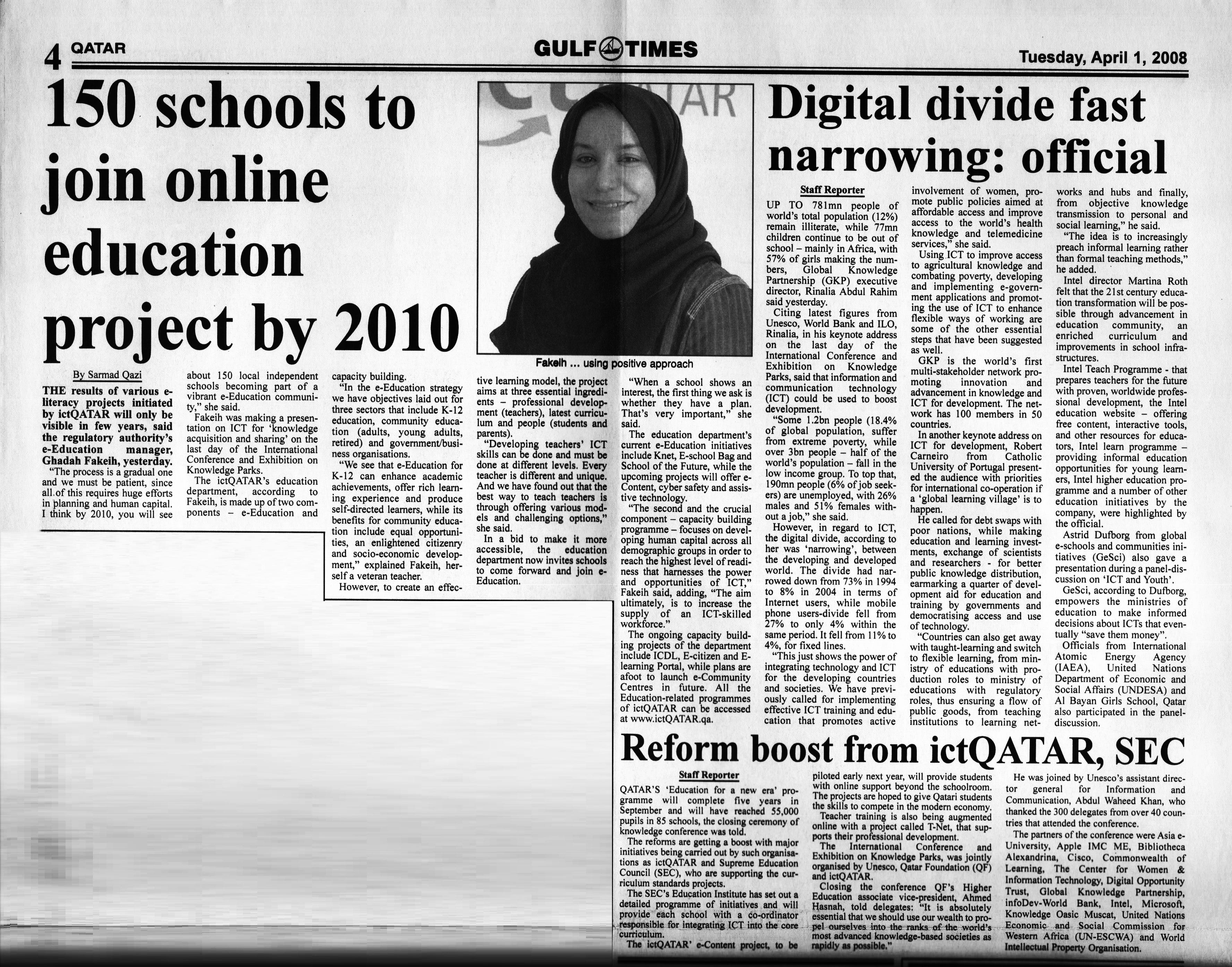
150 schools to join online education project by 2010
Originally published in Gulf Times on April 1, 2008
THE results of various e-literacy projects initiated by ictQATAR will only be visible in few years, said the regulatory authority’s e-Education manager, Ghadah Fakeih, yesterday.
“The process is a gradual one and we must be patient, since all of this requires huge efforts in planning and human capital. I think by 2010, you will see about 150 local independent schools becoming part of a vibrant e-Education community,” she said.
Fakeih was making a presentation on ICT for “knowledge acquisition and sharing” on the last day of the International Conference and Exhibition on Knowledge Parks.
The ictQATAR’s education department, according to Fakeih, is made up of two components – e-Education and capacity building.
“In the e-Education strategy we have objectives laid out for three sectors that include K-12 education, community education (adults, young adults, retired) and government/business organisations.
“We see that e-Education for K-12 can enhance academic achievements, offer rich learning experience and produce self-directed learners, while its benefits for community education include equal opportunities, an enlightened citizenry and socio-economic development,” explained Fakeih, herself a veteran teacher.
However, to create an effective learning model, the project aims at three essential ingredients – professional development (teachers), latest curriculum and people (students and parents).
“Developing teachers’ ICT skills can be done and must be done at different levels. Every teacher is different and unique. And we have found out that the best way to teach teachers is through offering various models and challenging options,” she said.
In a bid to make it more accessible, the education department now invites schools to come forward and join e-Education.
“When a school shows an interest, the first thing we ask is whether they have a plan. That’s very important,” she said.
The education department’s current e-Education initiatives include Knet, e-School Bag and School of the Future, while the upcoming projects will offer e-Content, cyber safety and assistive technology.
“The second and the crucial component – capacity building programme – focuses on developing human capital across all demographic groups in order to reach the highest level of readiness that harnesses the power and opportunities of ICT,” Fakeih said, adding, “The aim ultimately, is to increase the supply of an ICT-skilled workforce.”
The ongoing capacity building projects of the department include ICDL, E-citizen and E-learning Portal, while plans are afoot to launch e-Community Centres in future. All the Education-related programmes of ictQATAR can be accessed at
As Published