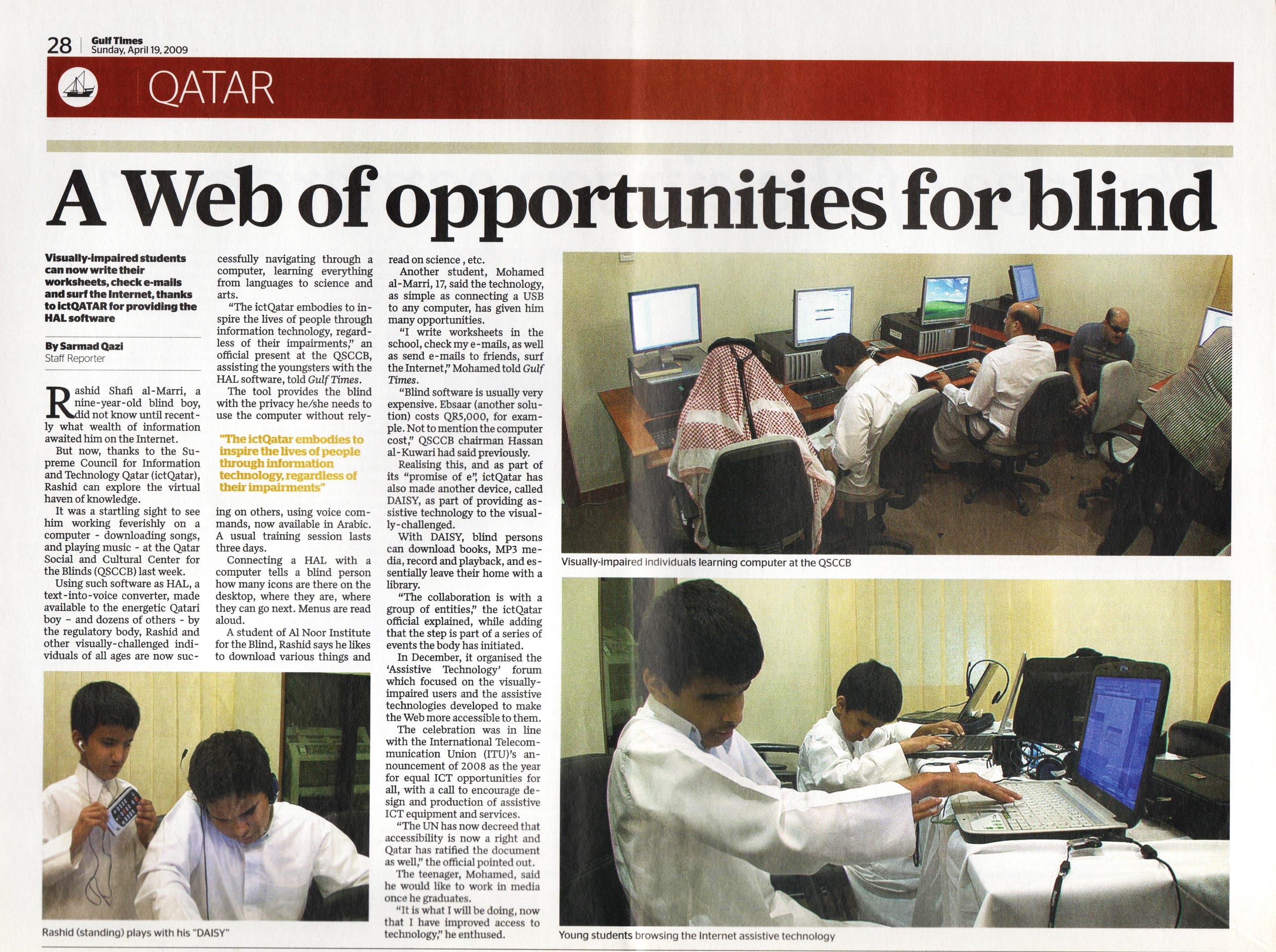
A Web of opportunities for the blind
Originally published in Gulf Times on April 19, 2009
Visually-impaired students can now write their worksheets, check e-mails and surf the Internet, thanks to ictQATAR for providing the HAL software
Rashid Shafi al-Marri, a nine-year-old blind boy, recently did not know what wealth of information awaited him on the Internet.
But now, thanks to the Supreme Council for Information and Technology Qatar (ictQatar), Rashid can explore the virtual heaven more widely.
It was a startling sight to see him working feverishly on a computer - downloading songs, and playing music - at the Qatar Social and Cultural Centre for The Blind (QSCCB) last week.
Using such software as HAL, a text-into-voice converter, made available to the energetic Qatari boy - and dozens of others - by the regulatory body, Rashid and other visually-challenged individuals of all ages are now successfully navigating through a computer, learning everything from languages to science and arts.
“The ictQatar embodies to inspire the lives of people through information technology regardless of their impairments,” an official present at the QSCCB, assisting the youngsters with the HAL software, told Gulf Times.
“The ictQatar embodies to inspire the lives of people through information technology, regardless of their impairments”
The tool provides the blind with the privacy he/she needs to use the computer without relying on others, using voice commands, now available in Arabic. A usual training session lasts three days.
Connecting a HAL with a computer tells a blind person how many icons are there on the desktop, where they are, where they can go next. Menus are read aloud.
A student of Al Noor Institute for the blind, Rashid says he likes to download various things and read on science, etc.
Another student, Mohamed al-Marri, 17, said the technology, as simple as connecting a USB to any computer, has given him many opportunities.
“I write worksheets in the school, check my e-mails, as well as send e-mails to friends over the Internet,” Mohamed told Gulf Times.
“Blind software is usually very expensive. Fbaar (another solution) costs QR3,000, for example. Not to mention the computer cost,” QSCCB chairman Hassan al-Kuwari had said previously.
Realising this, and as part of its “promise of e”, ictQatar has also made another device, called DAISY, as part of providing assistive technology to the visually-challenged.
With DAISY, blind persons can download books, MP3 media, record and playback, and essentially leave their home with a library.
“The collaboration is with a group of entities,” the ictQatar official explained, while adding that the step is part of a series of events the body has initiated.
In December, it organised the ‘Accessibility Technology’ forum which focused on the visually-impaired users and the assistive technologies developed to make the Web more accessible to them.
“The activation was in line with the International Telecommunication Union (ITU)‘s announcement of 2008 as the year for equal ICT opportunities for all, with a call to encourage design and production of assistive ICT equipment and services.
“The UN has now decreed that accessibility is now a right and Qatar has ratified the document as well,” the official pointed out.
The teenager, Mohamed, said he would like to work in media once he graduates.
“It is what I will be doing, now that I have improved access to technology,” he enthused.
[Photo captions]
Rashid (standing) plays with his “DAISY”
Visually-impaired individuals learning computer at the QSCCB
Young students browsing the Internet assistive technology
As Published