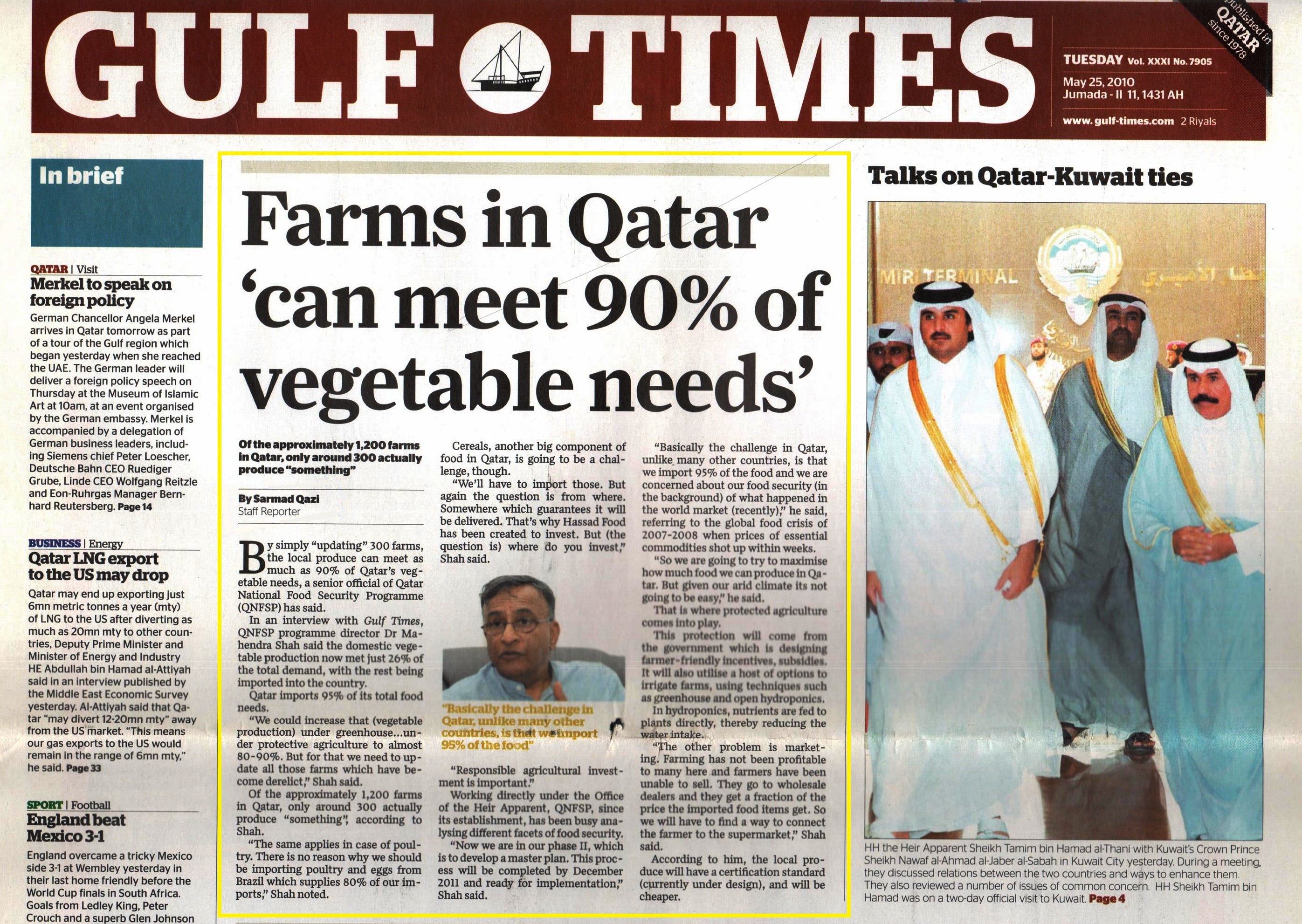
Farms in Qatar 'can meet 90% of vegetable needs'
Originally published in Gulf Times on May 25, 2010
Of the approximately 1,200 farms in Qatar, only around 300 actually produce “something”
By simply “updating” 300 farms, the local produce can meet as much as 90% of Qatar’s vegetable needs, a senior official of Qatar National Food Security Programme (QNFSP) has said.
In an interview with Gulf Times, QNFSP programme director Dr Mahendra Shah said the domestic vegetable production now met just 26% of the total demand, with the rest being imported into the country.
Qatar imports 95% of its total food needs.
“We could increase that (vegetable production) under greenhouse…under protective agriculture to almost 80-90%. But for that we need to update all those farms which have become derelict,” Shah said.
Of the approximately 1,200 farms in Qatar, only around 300 actually produce “something”, according to Shah.
“The same applies in case of poultry. There is no reason why we should be importing poultry and eggs from Brazil which supplies 80% of our imports,” Shah noted.
Cereals, another big component of food in Qatar, is going to be a challenge, though.
“We’ll have to import those. But again the question is from where. Somewhere which guarantees it will be delivered. That’s why Hassad Food has been created to invest. But (the question is) where do you invest,” Shah said.
“Responsible agricultural investment is important.”
Working directly under the Office of the Heir Apparent, QNFSP, since its establishment, has been busy analysing different facets of food security.
“Now we are in our phase II, which is to develop a master plan. This process will be completed by December 2011 and ready for implementation,” Shah said.
“Basically the challenge in Qatar, unlike many other countries, is that we import 95% of the food and we are concerned about our food security (in the background) of what happened in the world market (recently),” he said, referring to the global food crisis of 2007-2008 when prices of essential commodities shot up within weeks.
“So we are going to try to maximise how much food we can produce in Qatar. But given our arid climate its not going to be easy,” he said.
That is where protected agriculture comes into play.
This protection will come from the government which is designing farmer-friendly incentives, subsidies. It will also utilise a host of options to irrigate farms, using techniques such as greenhouse and open hydroponics.
In hydroponics, nutrients are fed to plants directly, thereby reducing the water intake.
“The other problem is marketing. Farming has not been profitable to many here and farmers have been unable to sell. They go to wholesale dealers and they get a fraction of the price the imported food items get. So we will have to find a way to connect the farmer to the supermarket,” Shah said.
According to him, the local produce will have a certification standard (currently under design), and will be cheaper.
As Published