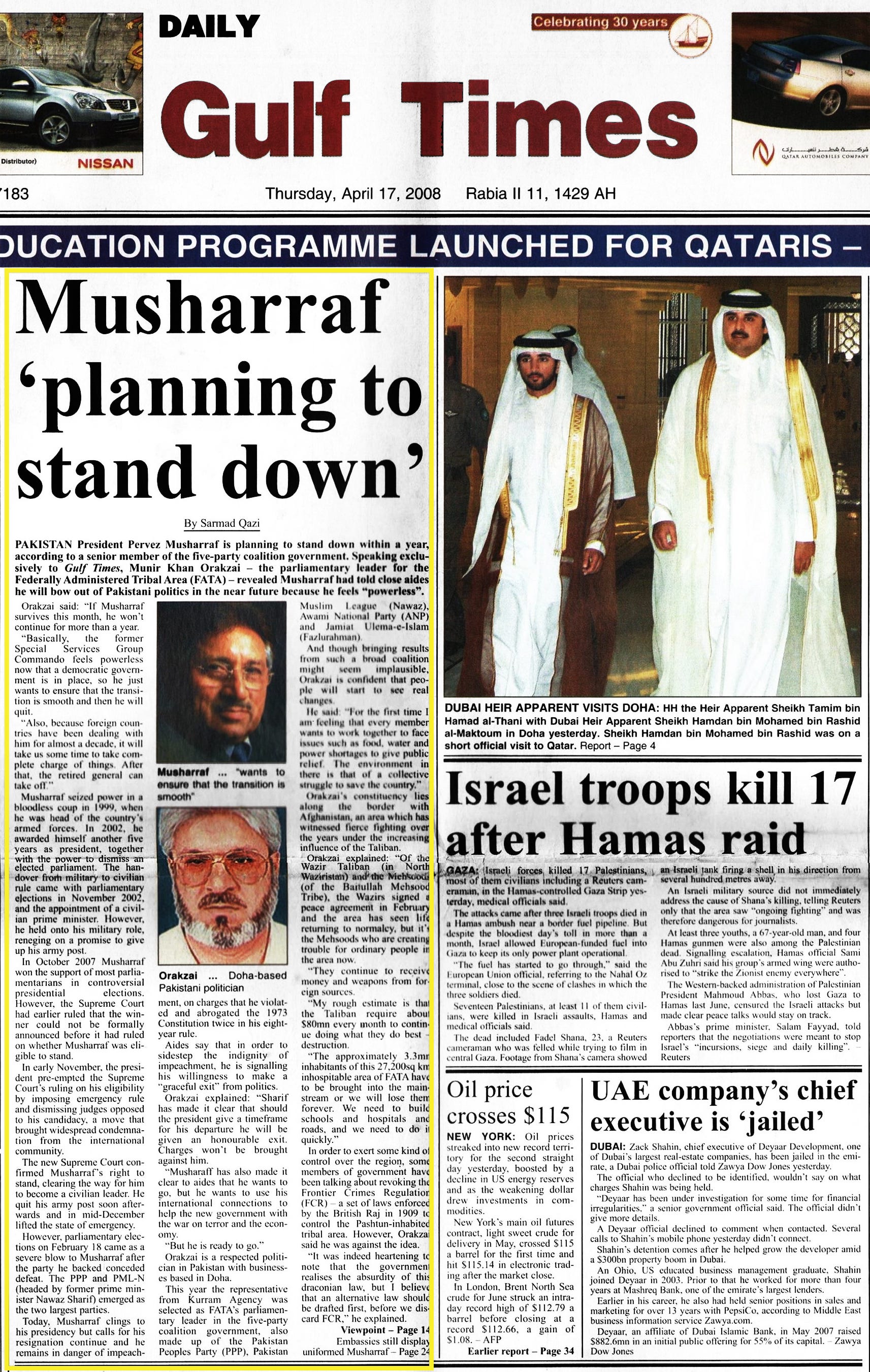
Musharraf 'planning to stand down'
Originally published in Gulf Times on April 17, 2008
PAKISTAN President Pervez Musharraf is planning to stand down within a year, according to a senior member of the five-party coalition government. Speaking exclusively to Gulf Times, Munir Khan Orakzai – the parliamentary leader for the Federally Administered Tribal Area (FATA) – revealed Musharraf had lost close aides and he will opt out of politics in the near future because he feels “powerless”.
Orakzai said: “If Musharraf survives this month, he won’t continue for more than a year.
“Basically, the former Special Services Group Commando feels powerless now that a democratic government is in place, so he just wants to ensure that the transition is smooth and then he will quit.
“Also, because foreign countries have been dealing with him directly for almost a decade, it will take us some time to take complete charge of things. After that, the retired general can take off.”
Musharraf seized power in a bloodless coup in 1999, when he was head of the country’s armed forces. In 2002, he awarded himself another five years as president, together with the power to dismiss an elected parliament. The handover from military to civilian rule came with parliamentary elections in November 2002, and the appointment of a civilian prime minister. However, he held onto his military role, reneging on a promise to give up his army post.
In October 2007 Musharraf won the support of most parliamentarians in controversial presidential elections. However, the Supreme Court had earlier ruled that the winner could not be formally announced before it had ruled on whether Musharraf was eligible to stand.
In early November, the president pre-empted the Supreme Court’s ruling on his eligibility by imposing emergency rule and dismissing judges opposed to his candidacy, a move that brought widespread condemnation from the international community.
The new Supreme Court confirmed Musharraf’s right to stand, clearing the way for him to become a civilian leader. He quit his army post soon afterwards and in mid-December lifted the state of emergency.
However, parliamentary elections on February 18 came as a severe blow to Musharraf after the party he backed conceded defeat. The PPP and PML-N (headed by former prime minister Nawaz Sharif) emerged as the two largest parties.
Today, Musharraf clings to his presidency but calls for his resignation continue and he remains in danger of impeachment, on charges that he violated and abrogated the 1973 Constitution twice in his eight-year rule.
Aides say that in order to sidestep the indignity of impeachment, he is signalling his willingness to make a “graceful exit” from politics.
Orakzai explained: “Sharif has made it clear that should the president give a timeframe for his departure he will be given an honourable exit. Charges won’t be brought against him.
“Musharraf has also made it clear to aides that he wants to go, but he wants to use his international connections to help the new government with the war on terror and the economy.
“But he is ready to go.”
Orakzai is a respected politician in Pakistan with businesses based in Doha.
This year the representative from Kurram Agency was selected as FATA’s parliamentary leader in the five-party coalition government, also made up of the Pakistan Peoples Party (PPP), Pakistan Muslim League (Nawaz), Awami National Party (ANP) and Jamiat Ulema-e-Islam (Fazlurahman).
And though bringing results from such a broad coalition might seem implausible, Orakzai is confident that people will start to see real changes.
He said: “Fors the first time I am feeling that every member wants to work together to face issues such as food, water and power shortages to give public relief. The environment in there is that of a collective struggle to save the country.”
Orakzai’s constituency lies along the border with Afghanistan, an area which has witnessed fierce fighting over the years under the increasing influence of the Taliban.
Orakzai explained: “Of the Wazir Taliban (in North Waziristan) and the Mehsoods (of the Baitullah Mehsood Tribe), the Wazirs signed a peace agreement in February and the area has seen life returning to normalcy, but it’s the Mehsoods who are creating trouble for ordinary people in the area now.
“They continue to receive money and weapons from foreign sources.
“My rough estimate is that the Taliban require about $80mn every month to continue doing what they do best - destruction.
“The approximately 3.3mn inhabitants of this 27,200sq km inhospitable area of FATA have to be brought into the mainstream or we will lose them forever. We need to build schools and hospitals and roads, and we need to do it quickly.”
In order to exert some kind of control over the region, some members of government have been talking about revoking the Frontier Crimes Regulation (FCR) - a set of laws enforced by the British Raj in 1909 to control the Pashtun-inhabited tribal area. However, Orakzai said he was against the idea.
“It was indeed heartening to note that the government realises the absurdity of this draconian law, but I believe that an alternative law should be drafted first, before we discard FCR,” he explained.
As Published