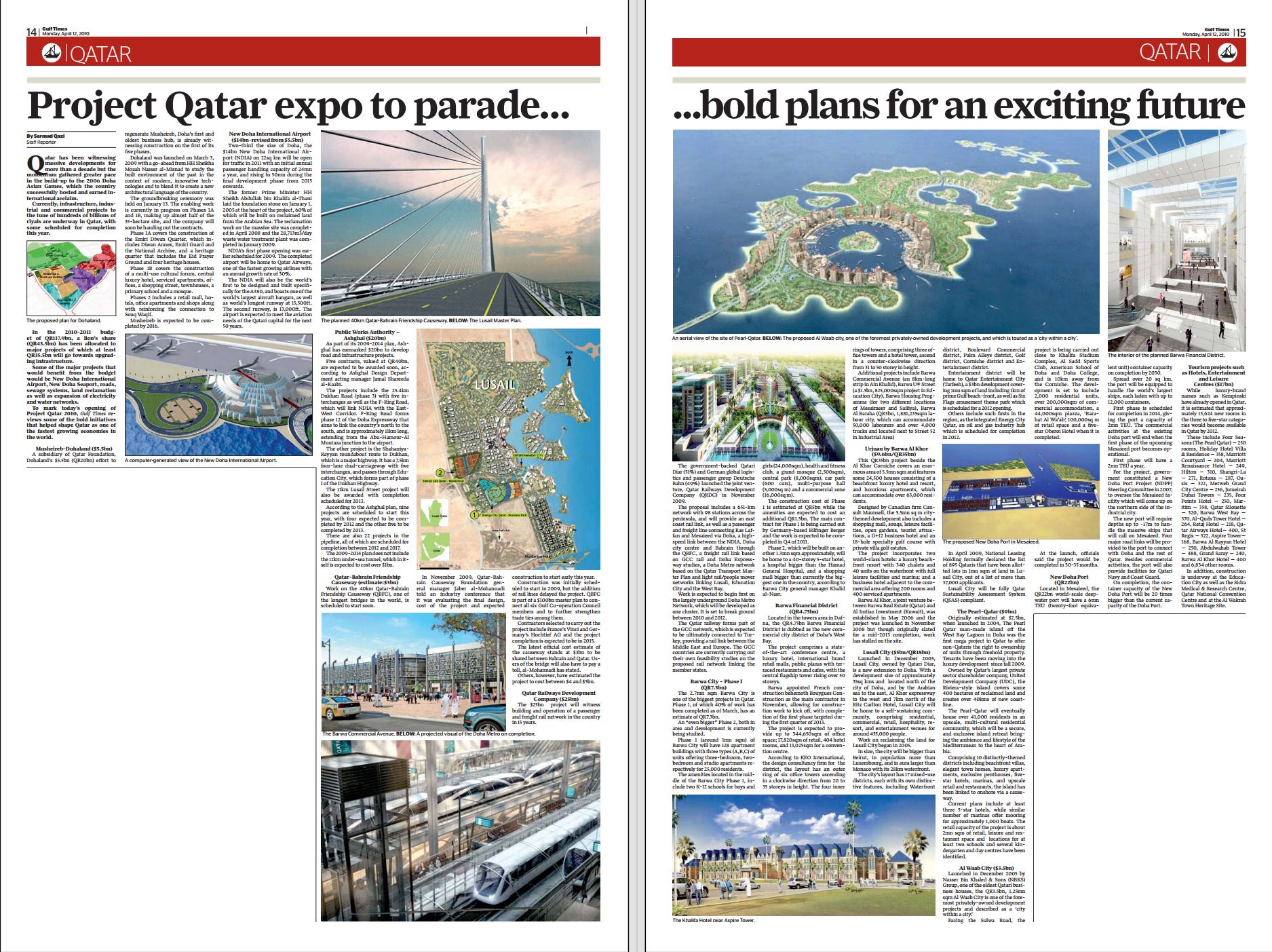
Project Qatar expo to parade bold plans for an exciting future
Originally published in Gulf Times on April 12, 2010
Qatar has been witnessing massive developments for more than a decade but the momentum gathered greater pace in the build-up to the 2006 Doha Asian Games, which the country successfully hosted and earned international acclaim.
Currently, infrastructure, industrial and commercial projects to the tune of hundreds of billions of riyals are underway in Qatar, with some scheduled for completion this year. In the 2010-2011 budget of QR117.9bn, a lion’s share (QR43.5bn) has been allocated to major projects of which at least QR35.5bn will go towards upgrading infrastructure.
Some of the major projects that would benefit from the budget would be New Doha International Airport, New Doha Seaport, roads, sewage systems, land reclamation as well as expansion of electricity and water networks. To mark today’s opening of Project Qatar 2010, Gulf Times reviews some of the bold initiatives that helped shape Qatar as one of the fastest growing economies in the world.
Musheireb-Dohaland ($5.5bn) A subsidiary of Qatar Foundation, Dohaland’s $5.5bn (QR20bn) eff ort to regenerate Musheireb, Doha’s first and oldest business hub, is already witnessing construction on the first of its five phases.
Dohaland was launched on March 3, 2009 with a go-ahead from HH Sheikha Mozah Nasser al-Misnad to study the built environment of the past in the context of modern, innovative technologies and to blend it to create a new architectural language of the country.
The groundbreaking ceremony was held on January 13. The enabling work is currently in progress on Phases 1A and 1B, making up almost half of the 35-hectare site, and the company will soon be handing out the contracts.
Phase 1A covers the construction of the Emiri Diwan Quarter, which includes Diwan Annex, Emiri Guard and the National Archive, and a heritage quarter that includes the Eid Prayer Ground and four heritage houses.
Phase 1B covers the construction of a multi-use cultural forum, central luxury hotel, serviced apartments, offices, a shopping street, townhouses, a primary school and a mosque. Phases 2 includes a retail mall, hotels, office apartments and shops along with reinforcing the connection to Souq Waqif.
Musheireb is expected to be completed by 2016. New Doha International Airport ($14bn-revised from $5.5bn) Two-third the size of Doha, the $14bn New Doha International Airport (NDIA) on 22sq km will be open for traffic in 2011 with an initial annual passenger handling capacity of 24mn a year, and rising to 50mn during the final development phase from 2015 onwards.
The former Prime Minister HH Sheikh Abdullah bin Khalifa al-Thani laid the foundation stone on January 1, 2005 at the heart of the project, 60% of which will be built on reclaimed land from the Arabian Sea.
The reclamation work on the massive site was completed in April 2008 and the 28,713m3/day waste water treatment plant was completed in January 2009. NDIA’s first phase opening was earlier scheduled for 2009.
The completed airport will be home to Qatar Airways, one of the fastest growing airlines with an annual growth rate of 30%.
The NDIA will also be the world’s first to be designed and built specifically for the A380, and boasts one of the world’s largest aircraft hangars, as well as world’s longest runway at 15,500ft.
The second runway, is 13,000ft. The airport is expected to meet the aviation needs of the Qatari capital for the next 50 years. Public Works Authority — Ashghal ($20bn) As part of its 2009-2014 plan, Ashghal has earmarked $20bn to develop road and infrastructure projects.
Five contracts, valued at QR40bn, are expected to be awarded soon, according to Ashghal Design Department acting manager Jamal Shareeda al-Kaabi.
The projects include the 25.4km Dukhan Road (phase 3) with five interchanges as well as the F-Ring Road, which will link NDIA with the East-West Corridor.
F-Ring Road forms phase 12 of the Doha Expressway that aims to link the country’s north to the south, and is approximately 11km long, extending from the Abu-Hamour-Al Muntaza junction to the airport. The other project is the Shahaniya-Rayyan roundabout route to Dukhan, which is a major highway.
It has a 7.5km four-lane dual-carriageway with five interchanges, and passes through Education City, which forms part of phase I of the Dukhan Highway.
The 11km Lusail Street project will also be awarded with completion scheduled for 2013. According to the Ashghal plan, nine projects are scheduled to start this year, with four expected to be completed by 2012 and the other five to be completed by 2013.
There are also 22 projects in the pipeline, all of which are scheduled for completion between 2012 and 2017. The 2009-2014 plan does not include the 12km under-sea tunnel, which in itself is expected to cost over $1bn. Qatar-Bahrain Friendship Causeway (estimate: $3bn) Work on the 40km Qatar-Bahrain Friendship Causeway (QBFC), one of the longest bridges in the world, is scheduled to start soon.
In November 2009, Qatar-Bahrain Causeway Foundation general manager Jaber al-Mohannadi told an industry conference that it was evaluating the final design, cost of the project and expected construction to start early this year.
Construction was initially scheduled to start in 2009, but the addition of rail lines delayed the project. QBFC is part of a $100bn master plan to connect all six Gulf Co-operation Council members and to further strengthen trade ties among them.
Contractors selected to carry out the project include France’s Vinci and Germany’s Hochtief AG and the project completion is expected to be in 2015.
The latest official cost estimate of the causeway stands at $3bn to be shared between Bahrain and Qatar. Users of the bridge will also have to pay a toll, al-Mohannadi has stated.
Others, however, have estimated the project to cost between $4 and $5bn. Qatar Railways Development Company ($25bn) The $25bn project will witness building and operation of a passenger and freight rail network in the country in 15 years.
The government-backed Qatari Diar (51%) and German global logistics and passenger group Deutsche Bahn (49%) launched the joint venture, Qatar Railways Development Company (QRDC) in November 2009.
The proposal includes a 651-km network with 98 stations across the peninsula, and will provide an east coast rail link, as well as a passenger and freight line connecting Ras Laffan and Mesaieed via Doha, a highspeed link between the NDIA, Doha city centre and Bahrain through the QBFC, a freight rail link based on GCC rail and Doha Expressway studies, a Doha Metro network based on the Qatar Transport Master Plan and light rail/people mover networks linking Lusail, Education City and the West Bay.
Work is expected to begin first on the largely underground Doha Metro Network, which will be developed as one cluster. It is set to break ground between 2010 and 2012.
The Qatar railway forms part of the GCC network, which is expected to be ultimately connected to Turkey, providing a rail link between the Middle East and Europe.
The GCC countries are currently carrying out their own feasibility studies on the proposed rail network linking the member states. Barwa City – Phase I (QR7.3bn) The 2.7mn sqm Barwa City is one of the biggest projects in Qatar. Phase 1, of which 40% of work has been completed as of March, has an estimate of QR7.3bn. An “even bigger” Phase 2, both in area and development is currently being studied.
Phase 1 (around 1mn sqm) of Barwa City will have 128 apartment buildings with three types (A,B,C) of units offering three-bedroom, twobedroom and studio apartments respectively for 25,000 residents. The amenities located in the middle of the Barwa City Phase 1, include two K-12 schools for boys and girls (24,000sqm), health and fitness club, a grand mosque (2,500sqm), central park (8,000sqm), car park (600 cars), multi-purpose hall (5,000sq m) and a commercial zone (16,000sq m).
The construction cost of Phase 1 is estimated at QR5bn while the amenities are expected to cost an additional QR1.5bn. The main contract for Phase 1 is being carried out by Germany-based Bilfinger Berger and the work is expected to be completed in Q4 of 2011.
Phase 2, which will be built on another 1.3mn sqm approximately, will be home to a 40-storey 5-star hotel, a hospital bigger than the Hamad General Hospital, and a shopping mall bigger than currently the biggest one in the country, according to Barwa City general manager Khalid al-Nasr.
Barwa Financial District (QR4.75bn) Located in the towers area in Dafna, the QR4.75bn Barwa Financial District is dubbed as the new commercial city district of Doha’s West Bay.
The project comprises a state-of-the-art conference centre, a luxury hotel, international brand retail malls, public plazas with terraced restaurants and cafes, with the central flagship tower rising over 50 storeys.
Barwa appointed French construction behemoth Bouygues Construction as the main contractor in November, allowing for construction work to kick off, with completion of the first phase targeted during the first quarter of 2013.
The project is expected to provide up to 344,650sqm of office space; 17,820sqm of retail, 404 hotel rooms, and 13,025sqm for a convention centre.
According to KEO International, the design consultancy fi rm for the district, the layout has an outer ring of six office towers ascending in a clockwise direction from 20 to 35 storeys in height.
The four inner rings of towers, comprising three office towers and a hotel tower, ascend in a counter-clockwise direction from 31 to 50 storey in height. Additional projects include Barwa Commercial Avenue (an 8km-long strip in Ain Khalid), Barwa U® Street (a $1.5bn, 825,000sqm project in Education City), Barwa Housing Programme (for two different locations of Mesaimeer and Sailiya), Barwa Al Baraha (QR3bn, 1,881,235sqm labour city, which can accommodate 50,000 labourers and over 4,000 trucks and located next to Street 52 in Industrial Area) Urjuan by Barwa Al Khor ($9.6bn/QR35bn) This QR35bn project beside the Al Khor Corniche covers an enormous area of 5.5mn sqm and features some 24,500 houses consisting of a beachfront luxury hotel and resort, and luxurious apartments, which can accommodate over 63,000 residents.
Designed by Canadian firm Cansult Maunsell, the 5.5mn sq m city-themed development also includes a shopping mall, souqs, leisure facilities, open gardens, tourist attractions, a G+12 business hotel and an 18-hole specialty golf course with private villa golf estates.
The project incorporates two world-class hotels: a luxury beach-front resort with 340 chalets and 40 units on the waterfront with full leisure facilities and marina; and a business hotel adjacent to the commercial area offering 200 rooms and 400 serviced apartments.
Barwa Al Khor, a joint venture between Barwa Real Estate (Qatar) and Al Imtiaz Investment (Kuwait), was established in May 2006 and the project was launched in November 2008 but though originally slated for a mid-2013 completion, work has stalled on the site.
Lusail City ($5bn/QR18bn) Launched in December 2005, Lusail City, owned by Qatari Diar, is a new extension to Doha.
With a development size of approximately 35sq kms and located north of the city of Doha, and by the Arabian sea to the east, Al Khor expressway to the west and 7km north of the Ritz Carlton Hotel, Lusail City will be home to a self-sustaining community, comprising residential, commercial, retail, hospitality, resort, and entertainment venues for around 455,000 people.
Work on reclaiming the land for Lusail City began in 2005. In size, the city will be bigger than Beirut, in population more than Luxembourg, and in aura larger than Monaco with its 28km waterfront.
The city’s layout has 17 mixed-use districts, each with its own distinctive features, including Waterfront district, Boulevard Commercial district, Palm Alleys district, Golf district, Corniche district and Entertainment district. Entertainment district will be home to Qatar Entertainment City (Tarfeeh), a $3bn development covering 1mn sqm of land including 1km of prime Gulf beach-front, as well as Six Flags amusement theme park which is scheduled for a 2012 opening.
Others include such firsts in the region, as the integrated Energy City Qatar, an oil and gas industry hub which is scheduled for completion in 2012.
In April 2009, National Leasing Holding formally declared the list of 895 Qataris that have been allotted lots in 1mn sqm of land in Lusail City, out of a list of more than 37,000 applicants. Lusail City will be fully Qatar Sustainability Assessment System (QSAS) compliant.
The Pearl-Qatar ($9bn) Originally estimated at $2.5bn, when launched in 2004, The Pearl Qatar man-made island off the West Bay Lagoon in Doha was the first mega project in Qatar to off er non-Qataris the right to ownership of units through freehold property.
Tenants have been moving into the luxury development since fall 2009. Owned by Qatar’s largest private sector shareholder company, United Development Company (UDC), the Riviera-style island covers some 400 hectares of reclaimed land and creates over 40kms of new coastline.
The Pearl-Qatar will eventually house over 41,000 residents in an upscale, multi-cultural residential community, which will be a secure, and exclusive island retreat bringing the ambience and lifestyle of the Mediterranean to the heart of Arabia.
Comprising 10 distinctly-themed districts including beachfront villas, elegant town homes, luxury apartments, exclusive penthouses, five-star hotels, marinas, and upscale retail and restaurants, the island has been linked to onshore via a causeway.
Current plans include at least three 5-star hotels, while similar number of marinas off er mooring for approximately 1,000 boats.
The retail capacity of the project is about 2mn sqm of retail, leisure and restaurant space and locations for at least two schools and several kindergarten and day centres have been identified.
Al Waab City ($3.5bn) Launched in December 2005 by Nasser Bin Khaled & Sons (NBKS) Group, one of the oldest Qatari business houses, the QR3.5bn, 1.25mn sqm Al Waab City is one of the foremost privately-owned development projects and described as a ‘city within a city.’
Facing the Salwa Road, the project is being carried out close to Khalifa Stadium Complex, Al Sadd Sports Club, American School of Doha and Doha College, and is 10km away from the Corniche.
The development is set to include 2,000 residential units, over 200,000sqm of commercial accommodation, a 44,000sqm piazza, ‘Barahat Al Wa’ab’, 100,000sq m of retail space and a five-star Oberoi Hotel when it is completed. At the launch, officials said the project would be completed in 30-35 months. New Doha Port (QR22bn) Located in Mesaieed, the QR22bn world-scale deep water port will have a 6mn TEU (twenty-foot equivalent unit) container capacity on completion by 2030.
Spread over 20 sq km, the port will be equipped to handle the world’s largest ships, each laden with up to 12,000 containers. First phase is scheduled for completion in 2014, giving the port a capacity of 2mn TEU. The commercial activities at the existing Doha port will end when the first phase of the upcoming Mesaieed port becomes operational. First phase will have a 2mn TEU a year.
For the project, government constituted a New Doha Port Project (NDPP) Steering Committee in 2007, to oversee the Mesaieed facility which will come up on the northern side of the industrial city.
The new port will require depths up to -17m to handle the massive ships that will call on Mesaieed. Four major road links will be provided to the port to connect with Doha and the rest of Qatar. Besides commercial activities, the port will also provide facilities for Qatari Navy and Coast Guard. On completion, the container capacity of the New Doha Port will be 20 times bigger than the current capacity of the Doha Port.
Tourism projects such as Hotels, Entertainment and Leisure Centres ($17bn)
While luxury-brand names such as Kempinski have already opened in Qatar, it is estimated that approximately 13,624 new rooms in the three to five-star categories would become available in Qatar by 2012.
These include Four Seasons (The Pearl Qatar) — 250 rooms, Holiday Hotel Villa & Residence — 358, Marriott Courtyard — 204, Marriott Renaissance Hotel — 249, Hilton — 310, Shangri-La — 271, Rotana — 287, Oasis — 322, Merweb Grand City Centre — 256, Jumeirah Dubai Towers — 235, Four Points Hotel — 250, Maritim — 358, Qatar Silouette — 320, Barwa West Bay — 370, Al-Quds Tower Hotel — 264, Retaj Hotel — 218, Qatar Airways Hotel— 400, St Regis — 322, Aspire Tower— 168, Barwa Al Rayyan Hotel — 250, Abdulwahab Tower — 488, Grand Saray — 240, Barwa Al Khor Hotel — 400 and 6,834 other rooms.
In addition, construction is underway at the Education City as well as the Sidra Medical & Research Centre, Qatar National Convention Centre and at the Al Wakrah Town Heritage Site.
As Published