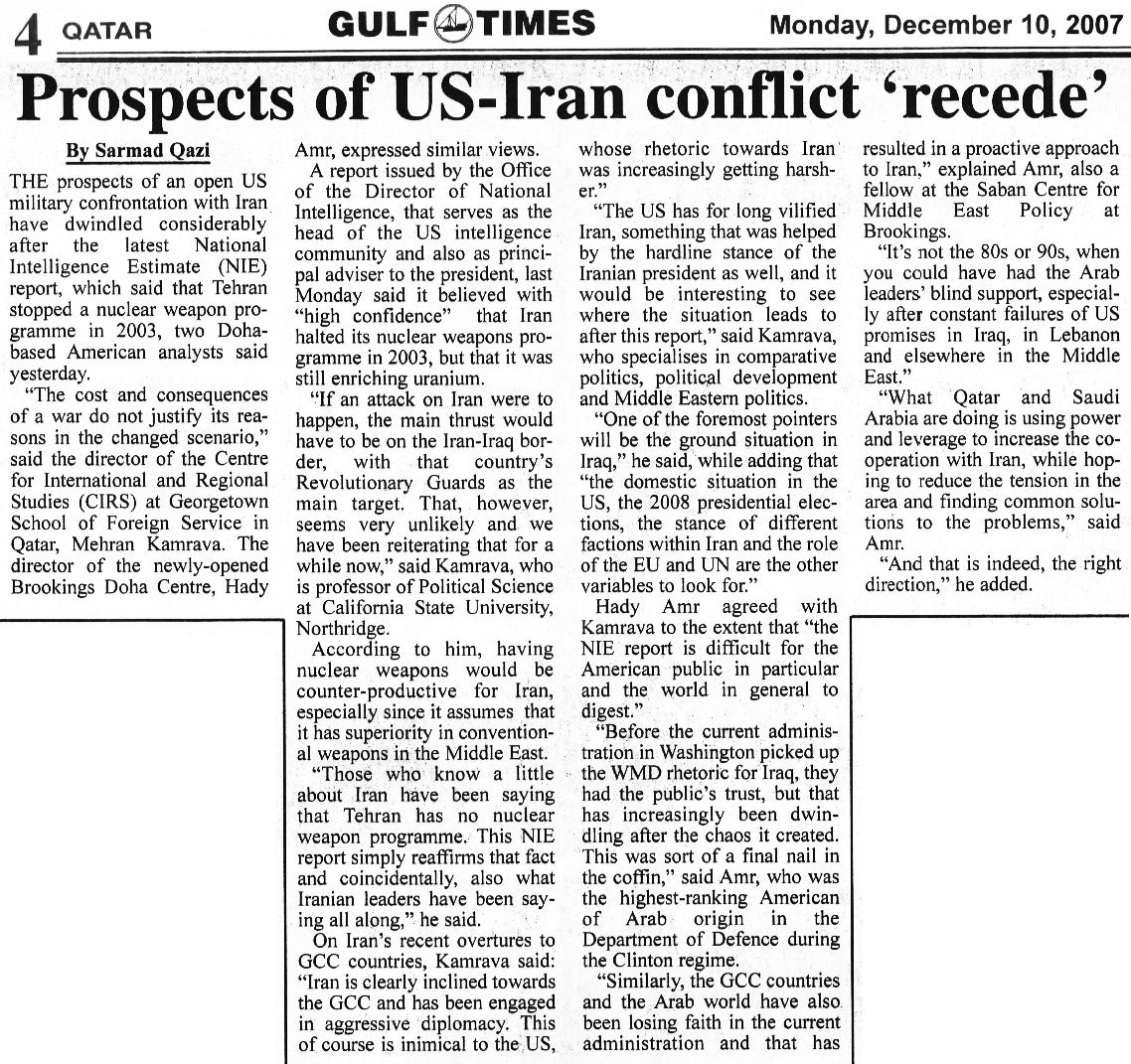
Prospects of US-Iran conflict 'recede'
Originally published in Gulf Times on December 10, 2007
THE prospects of an open US military confrontation with Iran have dwindled considerably after the latest National Intelligence Estimate (NIE) report, which said that Tehran stopped a nuclear weapon programme in 2003, two Doha based American analysts said yesterday.
“The cost and consequences of a war do not justify its reasons in the changed scenario,” said the director of the Centre for International and Regional Studies (CIRS) at Georgetown School of Foreign Service in Qatar, Mehran Kamrava. The director of the newly-opened Brookings Doha Centre, Hady Amr expressed similar views.
A report issued by the Office of the Director of National Intelligence, that serves as the head of the US intelligence community and also as principal adviser to the president, last Monday said it believed with “high confidence” that Iran halted its nuclear weapons programme in 2003, but that it was still enriching uranium.
“If an attack on Iran were to happen, the main thrust would have to be on the Iran-Iraq border, with that country’s Revolutionary Guards as the main target. That, however, seems very unlikely and we have been reiterating that for a while now,” said Kamrava, who is professor of Political Science at California State University, Northridge.
According to him, having nuclear weapons would be counter-productive for Iran, especially since it assumes that it has superiority in conventional weapons in the Middle East.
“Those who know a little about Iran have been saying that Tehran has no nuclear weapon programme. This NIE report simply reaffirms that fact and coincidentally, also what Iranian leaders have been saying all along,” he said.
On Iran’s recent overtures to GCC countries, Kamrava said: “Iran is clearly inclined towards the GCC and has been engaged in aggressive diplomacy. This of course is inimical to the US, whose rhetoric towards Iran was increasingly getting harsher.”
“The US has for long vilified Iran, something that was helped by the hardline stance of the Iranian president as well, and it would be interesting to see where the situation leads to after this report,” said Kamrava, who specialises in comparative politics, political development and Middle Eastern politics.
“One of the foremost pointers will be the ground situation in Iraq,” he said, while adding that “the domestic situation in the US, the 2008 presidential elections, the stance of different factions within Iran and the role of the EU and UN are the other variables to look for.”
Hady Amr agreed with Kamrava to the extent that “the NIE report is difficult for the American public in particular and the world in general to digest.”
“Before the current administration in Washington picked up the WMD rhetoric for Iraq, they had the public’s trust, but that has increasingly been dwindled after the chaos it created. This was sort of a final nail in the coffin,” said Amr, who was the highest-ranking American of Arab origin in the Department of Defence during the Clinton regime.
“Similarly, the GCC countries and the Arab world have also been losing faith in the current administration and that has resulted in a proactive approach to Iran,” explained Amr, also a fellow at the Saban Centre for Middle East Policy at Brookings.
“It’s not the 80s or 90s, when you could have had the Arab leaders’ blind support, especially after constant failures of US promises in Iraq, in Lebanon and elsewhere in the Middle East.”
“What Qatar and Saudi Arabia are doing is using power and leverage to increase the cooperation with Iran, while hoping to reduce the tension in the area and finding common solutions to the problems,” said Amr.
“And that is indeed, the right direction,” he added.
As Published