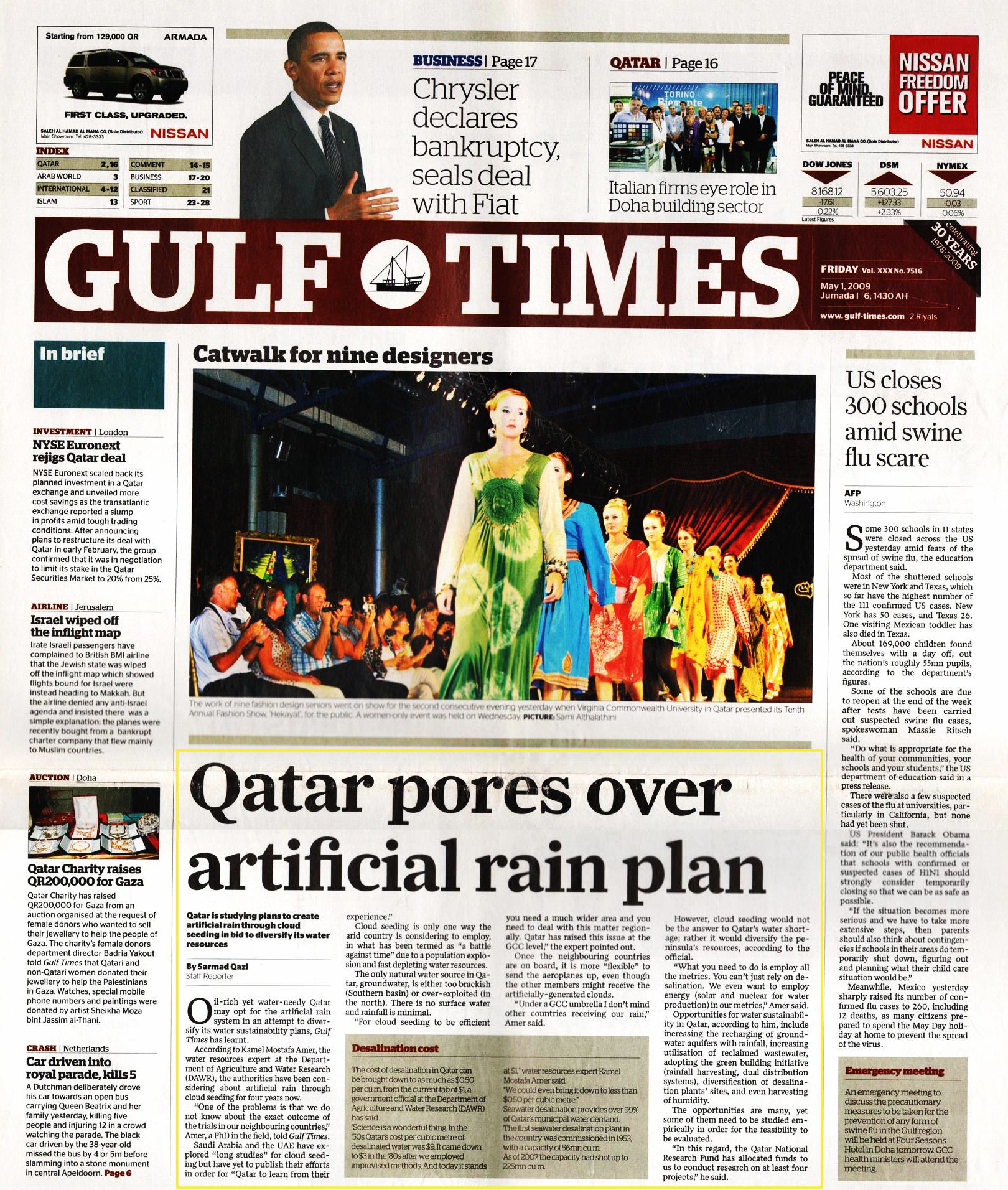
Qatar pores over artificial rain plan
Originally published in Gulf Times on May 1, 2009
Qatar is studying plans to create artificial rain through cloud seeding in bid to diversify its water resources
Oil-rich yet water-needy Qatar may opt for the artificial rain system in an attempt to diversify its water sustainability plans, Gulf Times has learnt.
According to Kamel Mostafa Amer, the water resources expert at the Department of Agriculture and Water Research (DAWR), the authorities have been considering about artificial rain through cloud seeding for two years now.
“One of the problems is that we do not know about the exact outcome of the trials in our neighbouring countries,” Amer, a PhD in the field, told Gulf Times.
Saudi Arabia and the UAE have explored “long studies” for cloud seeding but have yet to publish their efforts in order for “Qatar to learn from their experience.”
Cloud seeding is only one way the arid country is considering to employ, in what has been termed as “a battle against time” due to a population explosion and fast depleting water resources.
The only natural water source in Qatar, groundwater, is either too brackish (Southern basin) or over-exploited (in the north). There is no surface water and rainfall is minimal.
“For cloud seeding to be efficient you need a much wider area and you need to deal with this matter regionally. Qatar has raised this issue at the GCC level,” the expert pointed out.
Once the neighbouring countries are on board, it is more “flexible” to send the aeroplanes up, even though the other members might receive the artificially-generated clouds.
“Under a GCC umbrella I don’t mind other countries receiving our rain,” Amer said.
However, cloud seeding would not be the answer to Qatar’s water shortage; rather it would diversity the peninsula’s resources, according to the official.
“What you need to do is employ all the matrices. You can’t just rely on desalination. We even want to employ energy (solar and nuclear) for water production) in our metrics,” Amer said.
Opportunities for water sustainability in Qatar, according to him, include increasing the recharging of groundwater aquifers with rainfall, increasing utilisation of reclaimed wastewater, adopting the green building initiative (rainfall harvesting, dual distribution systems), diversification of desalination plants’ sites, and even harvesting of humidity.
The opportunities are many, yet some of them need to be studied empirically in order for the feasibility to be evaluated.
“In this regard, the Qatar National Research Fund has allocated funds to us to conduct research on at least four projects,” he said.
[Sidebar “Desalination cost”]
The cost of desalination in Qatar can be brought down to as much as $0.50 per cum from the current $0.81, a government official at the Department of Agriculture and Water Research (DAWR) has said.
“Science is a wonderful thing. In the ’50s Qatar’s cost per cubic metre of desalinated water was $9. It came down to $3 in the ’80s since we employed improved methods. And today it stands at $1,” water resources expert Kamel Mostafa Amer said.
“We could even bring it down to less than $0.50 per cubic metre.”
Seawater desalination provides over 99% of Qatar’s municipal water demands.
The first seawater desalination plant in the country was commissioned in 1953 with a capacity of 56mn cu m.
As of 2007 the capacity had shot up to 225mn cu m.
As Published