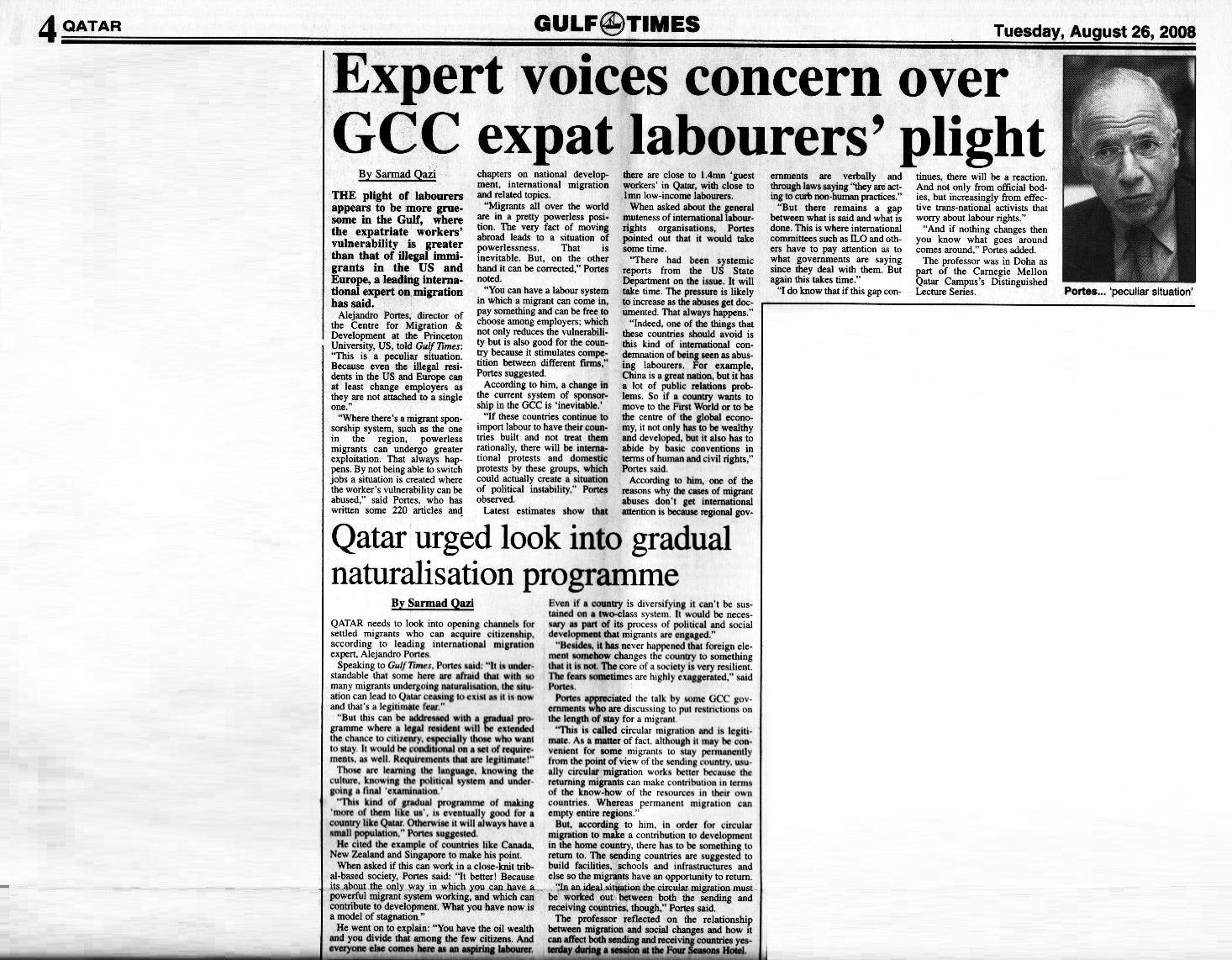
Qatar urged look into gradual naturalisation programme
Originally published in Gulf Times on August 26, 2008
QATAR needs to look into opening channels for settled migrants who can acquire citizenship, according to leading international migration expert, Alejandro Portes.
Speaking to Gulf Times, Portes said: “It is understandable that some here are afraid that with so many migrants undergoing naturalisation, the situation can lead to Qatar ceasing to exist as it is now and that’s a legitimate fear.”
“But this can be addressed with a gradual programme where a legal resident with tenure will have the chance to citizenship, especially those who want to stay. It would be conditional on a set of requirements, as well. Requirements that are legitimate. Those are learning the language, knowing the culture, knowing the political system and undergoing a final exam.”
“This kind of gradual programme of making room for the permanent right of abode for many countries like Qatar. Otherwise it will always have a small ruling population and an overwhelmingly huge labouring class.”
Portes used countries like Canada, Singapore, and New Zealand to make his point. “In a resource-based economy like a non-oil-based society, Portes said: “It better! Because that’s the only factor with which you can, and have controlled your development. What you have now is growth but no development.”
He went on to explain: “You have the oil wealth and you divide that among the few citizens. And everyone else comes here as an aspiring labourer.
Even if a country is diversifying it can’t be sustained on a two-class system. It would be necessary as part of its process of political and social development that migrants are engaged.”
“Besides, it has never happened that foreign element overtakes or changes the country to something that is not. The core of a society is very resilient. The fears sometimes are highly exaggerated.”
Portes appreciated the talk by some GCC governments who are beginning to put restrictions on the lengths of stay for a migrant.
The only way circular migration works, he said, is for the migrant to circulate and never have a legitimate mate. As a matter of fact, although it may be convenient for some migrants who have the high degree of skill to move from one place to another, in the long term circular migration works better because it ensures the migrant has something to return to.
However, Portes went on, in order for circular migration to work, there must be an efficient return policy which ensures when an individual goes back he is not penalised. He has something to come back to, his savings, his pension, and his legal status as a long term resident.
“In an ideal system, this can work. But here, the Gulf states need to decide if they are looking to incorporate people who are highly skilled, into their economy and give them a permanent home rather than just receiving productions,” Portes said.
He emphasised how crucial education is in moulding behaviours and social changes and how it can affect both sending and receiving countries during a session at the Four Seasons Hotel.
As Published