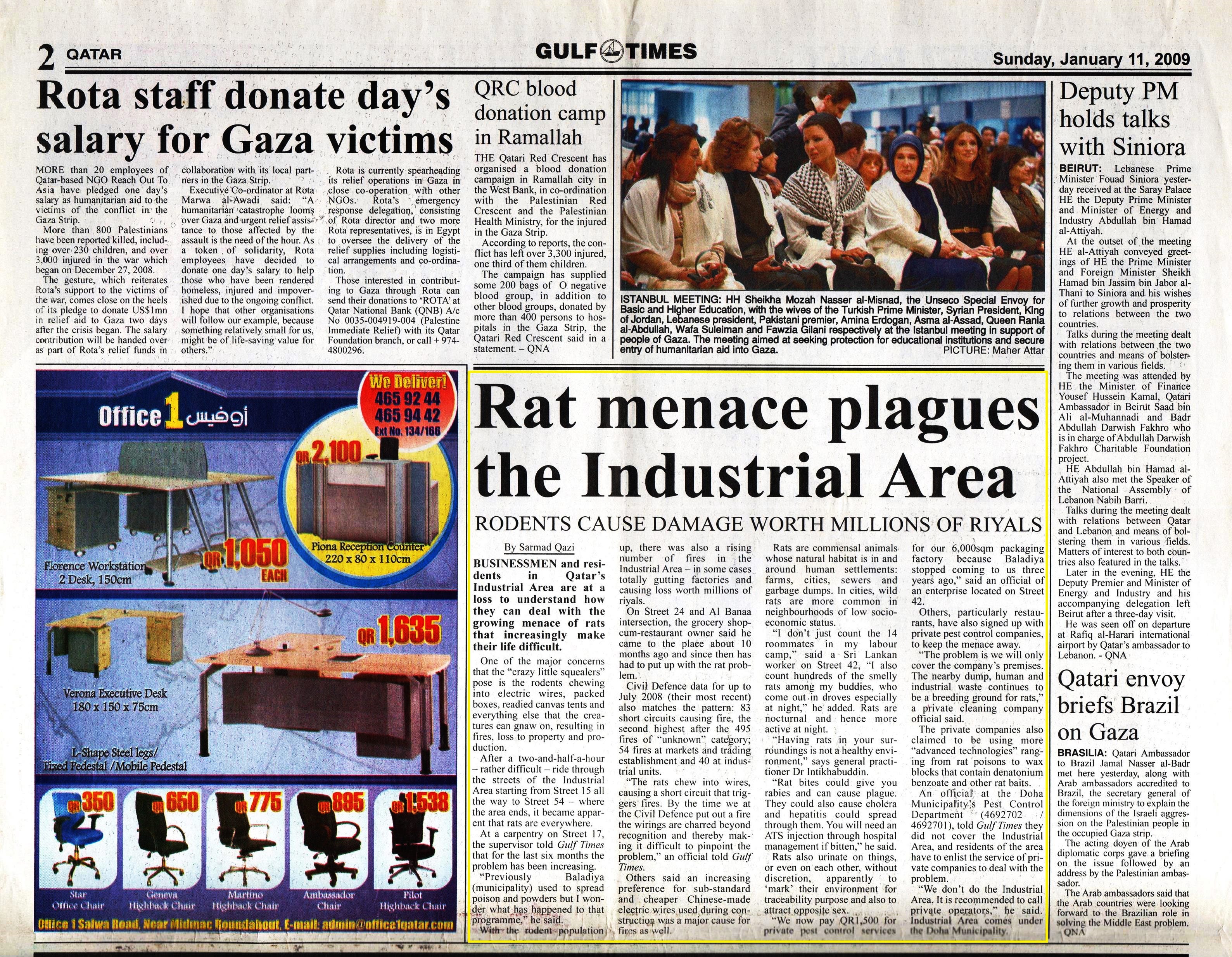
Rat menace plagues the Industrial Area
Originally published in Gulf Times on January 11, 2009
BUSINESSMEN and residents in Qatar’s Industrial Area are at a loss to understand how they can deal with the growing menace of rats that increasingly make their life difficult.
One of the major concerns that the “crazy little squealers” pose is the rodents chewing into electric wires, packed boxes, readied canvas tents and everything else that the creatures can gnaw on, resulting in fires, loss to property and production.
After a two-and-half-a-hour – rather difficult – ride through the streets of the Industrial Area starting from Street 15 all the way to Street 54 – where the area ends, it became apparent that rats are everywhere.
At a carpentry on Street 17, the supervisor told Gulf Times that for the last six months the problem has been increasing.
“Previously Baladiya (municipality) used to spread poison and powders but I wonder what has happened to that programme,” he said.
With the rodent population up, there was also a rising number of fires in the Industrial Area – in some cases totally gutting factories and causing loss worth millions of riyals.
On Street 24 and Al Banaa intersection, the grocery shop-cum-restaurant owner said he came to the place about 10 months ago and since then has had to put up with the rat problem.
Civil Defence data for up to July 2008 (their most recent) also matches the pattern: 83 short circuits causing fire, the second highest after the 495 fires of “unknown” category; 54 fires at markets and trading establishment and 40 at industrial units.
“The rats chew into wires, causing a short circuit that triggers fires. By the time we at the Civil Defence put out a fire the wirings are charred beyond recognition and thereby making it difficult to pinpoint the problem,” an official told Gulf Times.
Others said an increasing preference for sub-standard and cheaper Chinese-made electric wires used during construction was a major cause for fires as well.
Rats are commensal animals whose natural habitat is in and around human settlements: farms, cities, sewers and garbage dumps. In cities, wild rats are more common in neighbourhoods of low socio-economic status.
“I don’t just count the 14 roommates in my labour camp,” said a Sri Lankan worker on Street 42, “I also count hundreds of the smelly rats among my buddies, who come out in droves especially at night,” he added. Rats are nocturnal and hence more active at night.
“Having rats in your surroundings is not a healthy environment,” says general practitioner Dr Intikhabuddin.
“Rat bites could give you rabies and can cause plague. They could also cause cholera and hepatitis could spread through them. You will need an ATS injection through hospital management if bitten,” he said.
Rats also urinate on things, or even on each other, without discretion, apparently to “mark” their environment for traceability purpose and also to attract opposite sex.
“We now pay QR1,500 for private pest control services for our 6,000sqm packaging factory because Baladiya stopped coming to us three years ago,” said an official of an enterprise located on Street 42.
Others, particularly restaurants, have also signed up with private pest control companies, to keep the menace away.
“The problem is we will only cover the company’s premises. The nearby dump, human and industrial waste continues to be a breeding ground for rats,” a private cleaning company official said.
The private companies also claimed to be using more “advanced technologies” ranging from rat poisons to wax blocks that contain denatorium benzoate and other rat baits.
An official at the Doha Municipality’s Pest Control Department (4692702, 4692701), told Gulf Times they did not cover the Industrial Area, and residents of the area have to enlist the service of private companies to deal with the problem.
“We don’t do the Industrial Area. It is recommended to call private operators,” he said. Industrial Area comes under the Doha Municipality.
As Published