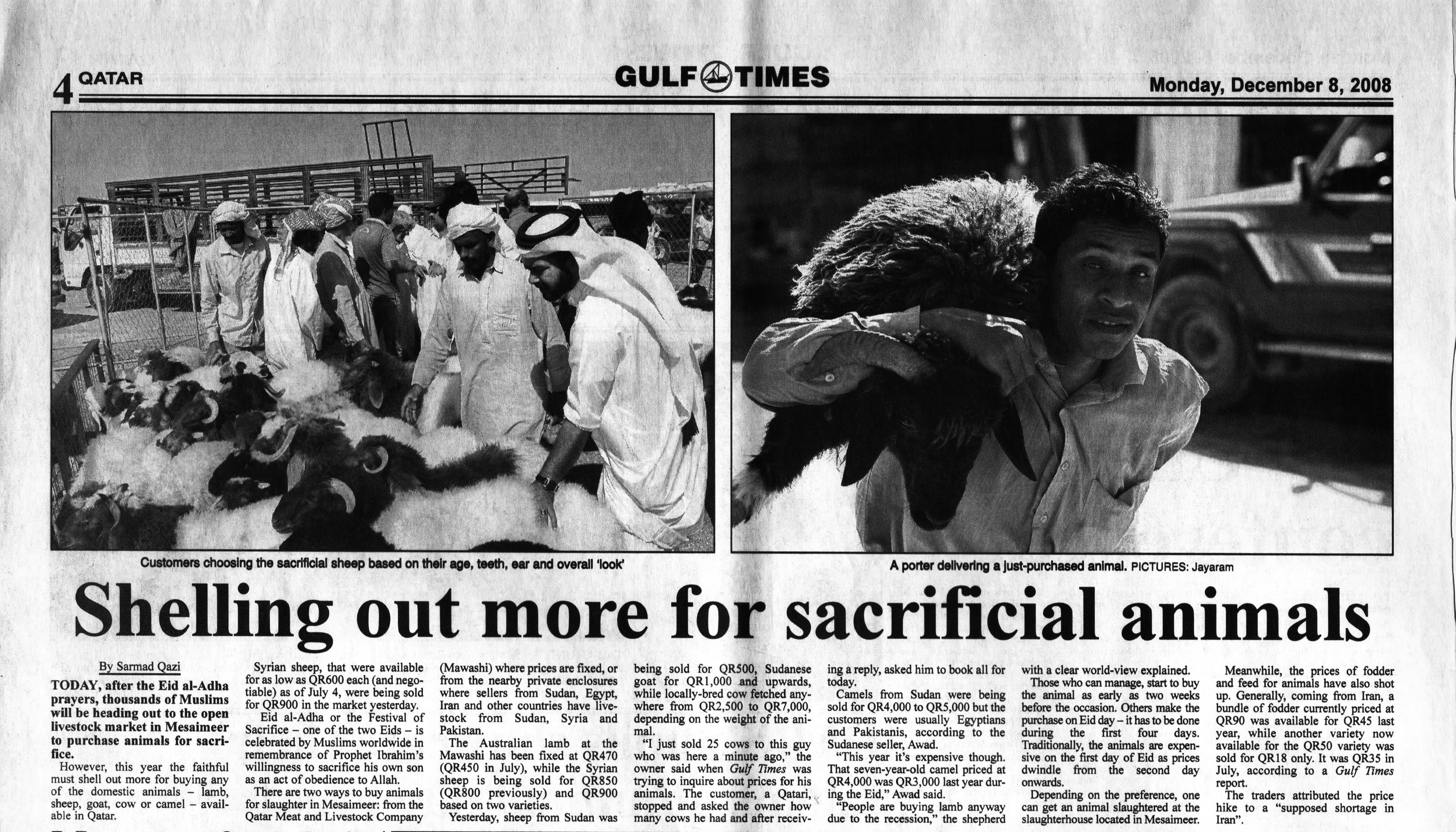
Shelling out more for sacrificial animals
Originally published in Gulf Times on December 8, 2008
TODAY, after the Eid al-Adha prayers, thousands of Muslims will be heading out to the open livestock market in Mesaimeer to purchase animals for sacrifice.
However, this year the faithful must shell out more for buying any of the domestic animals — lamb, sheep, goat, cow or camel — available in Qatar.
Syrian sheep, that were available for as low as QR600 each (and negotiable) as of July 4, were being sold for QR900 in the market yesterday.
Eid al-Adha or the Festival of Sacrifice — one of the two Eids — is celebrated by Muslims worldwide in remembrance of Prophet Ibrahim’s willingness to sacrifice his own son as an act of obedience to Allah.
There are two ways to buy animals for slaughter in Mesaimeer: from the Qatar Meat and Livestock Company (Mawashi) where prices are fixed, or from the nearby private enclosures where sellers from Sudan, Egypt, Iran and other countries have livestock from Sudan, Syria and Pakistan.
The Australian lamb at the Mawashi has been fixed at QR470 (QR450 in July), while the Syrian sheep is being sold for QR850 (QR800 previously) and QR900 based on two varieties.
Yesterday, sheep from Sudan was being sold for QR500, Sudanese goat for QR1,000 and upwards, while locally-bred cows fetched anywhere from QR2,500 to QR7,000, depending on the weight of the animal.
“I just sold 25 cows to this guy who was here a minute ago,” the owner said when Gulf Times was trying to inquire about prices for his animals. The customer, a Qatari, stopped and asked the owner how many cows he had and after receiving a reply, asked him to book all for today.
Camels from Sudan were being sold for QR4,000 to QR5,000 but the customers were usually Egyptians and Pakistanis, according to the Sudanese seller, Awad.
“This year it’s expensive though. That seven-year-old camel priced at QR4,000 was QR3,000 last year during the Eid,” Awad said.
“People are buying lamb anyway due to the recession,” the shepherd with a clear world-view explained.
Those who can manage, start to buy as early as two weeks before the occasion. Others make the purchase on Eid day — it has to be done within the first four days. Traditionally, the animals are expensive on the first day of Eid as prices dwindle from the second day onwards.
Depending on the preference, one can get an animal slaughtered at the slaughterhouse located in Mesaimeer.
Meanwhile, the prices of fodder and feed for animals have also shot up. Generally, coming from Iran, a bundle of fodder currently priced at QR90 was available for QR45 last year, while another variety now available for the QR50 variety was sold for QR18 only. It was QR35 in July, according to a Gulf Times report.
The traders attributed the price hike to a “supposed shortage in Iran”.
As Published