Students reject media curbs as 'suppression'
Originally published in Gulf Times on November 28, 2007
THE motion ‘This house believes that the media in the Middle East should be censored’ was rejected yesterday at the Student Debating Society of the Academic Bridge Program (ABP) by 11 votes.
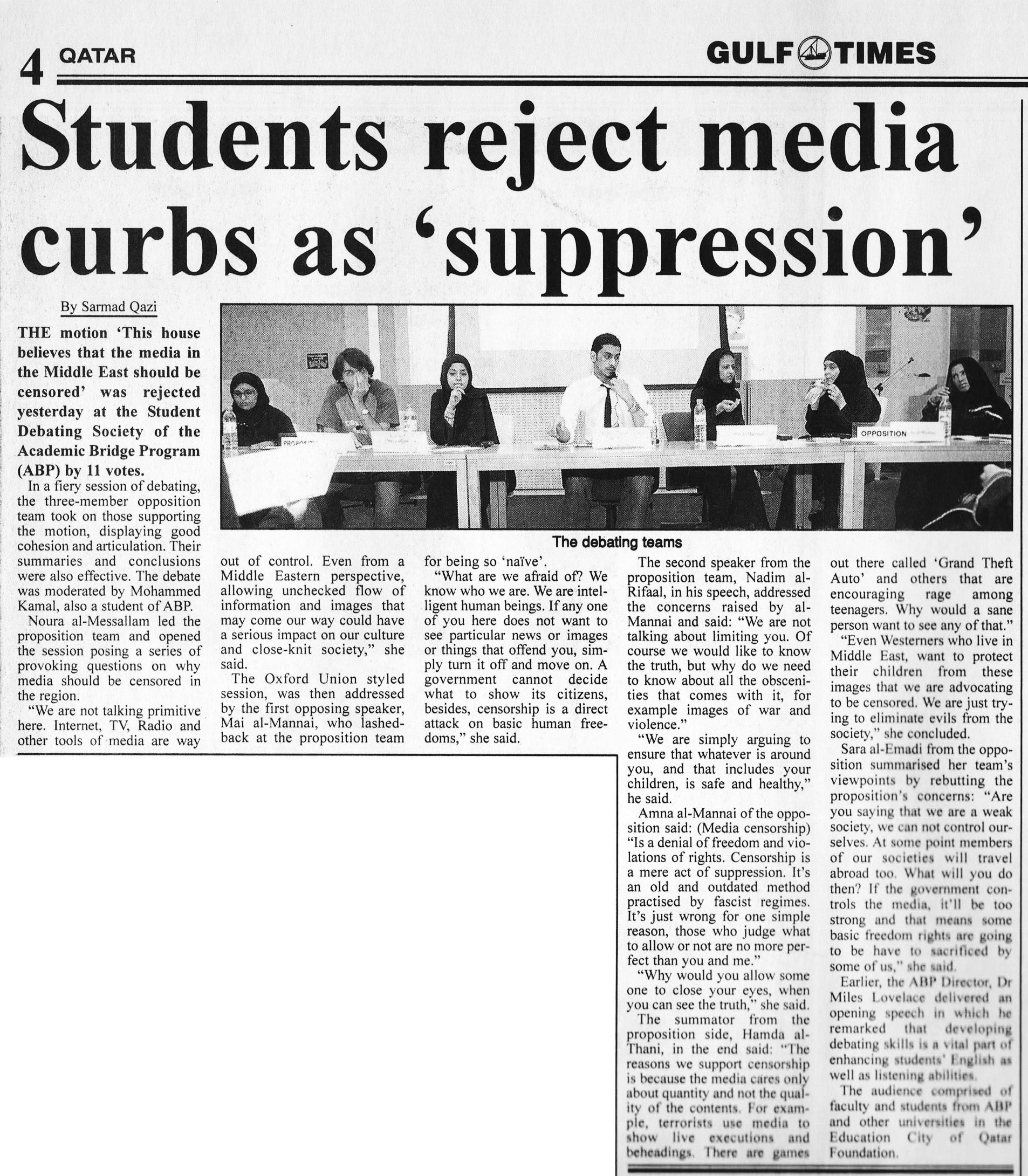
In a fiery session of debating, the three-member opposition team took on those supporting the motion, displaying good cohesion and articulation. Their summaries and conclusions were also effective. The debate was moderated by Mohammed Kamal, also a student of ABP.
Noura al-Messallam led the proposition team and opened the session posing a series of provoking questions on why media should be censored in the region.
“We are not talking primitive here. Internet, TV, Radio and other tools of media are way out of control. Even from a Middle Eastern perspective, allowing unchecked flow of information and images that may come our way could have a serious impact on our culture and close-knit society,” she said.
The Oxford Union styled session, was then addressed by the first opposing speaker, Mai al-Mannai, who lashed back at the proposition team for being so ‘naïve’.
“What are we afraid of? We know who we are. We are intelligent human beings. If any one of you here does not want to see particular news or images or things that offend you, simply turn it off and move on. A government cannot decide what to show its citizens, besides, censorship is a direct attack on basic human freedoms,” she said.
The second speaker from the proposition team, Nadim al-Ritaal, in his speech, addressed the concerns raised by al-Mannai and said: “We are not talking about limiting you. Of course we would like to know the truth, but why do we need to know about all the obscenities that comes with it, for example images of war and violence.”
“We are simply arguing to ensure that whatever is around you, and that includes your children, is safe and healthy,” he said.
Amna al-Mannai of the opposition said: (Media censorship) “Is a denial of freedom and violations of rights. Censorship is a mere act of suppression. It’s an old and outdated method practised by fascist regimes. It’s just wrong for one simple reason, those who judge what to allow or not are no more perfect than you and me.”
“Why would you allow someone to close your eyes, when you can see the truth,” she said.
The summator from the proposition side, Hamda alThani, in the end said: “The reasons we support censorship is because the media cares only about quantity and not the quality of the contents. For example, terrorists use media to show live executions and beheadings. There are games out there called ‘Grand Theft Auto’ and others that are encouraging rage among teenagers. Why would a sane person want to see any of that?”
“Even Westerners who live in Middle East want to protect their children from these images that we are advocating to be censored. We are just trying to eliminate evils from the society,” she concluded.
Sara al-Emadi from the opposition summarised her team’s viewpoints by rebutting the proposition’s concerns: “Are you saying that we are a weak society, we cannot control ourselves. At some point members of our societies will travel abroad too. What will you do then? If the government controls the media, it’ll be too strong and that means some basic freedom rights are going to be have to sacrificed by some of us,” she said.
Earlier, the ABP Director, Dr Miles Lovelace delivered an opening speech in which he remarked that developing debating skills is a vital part of enhancing students’ English as well as listening abilities.
The audience comprised of faculty and students from ABP and other universities in the Education City of Qatar Foundation.
As Published