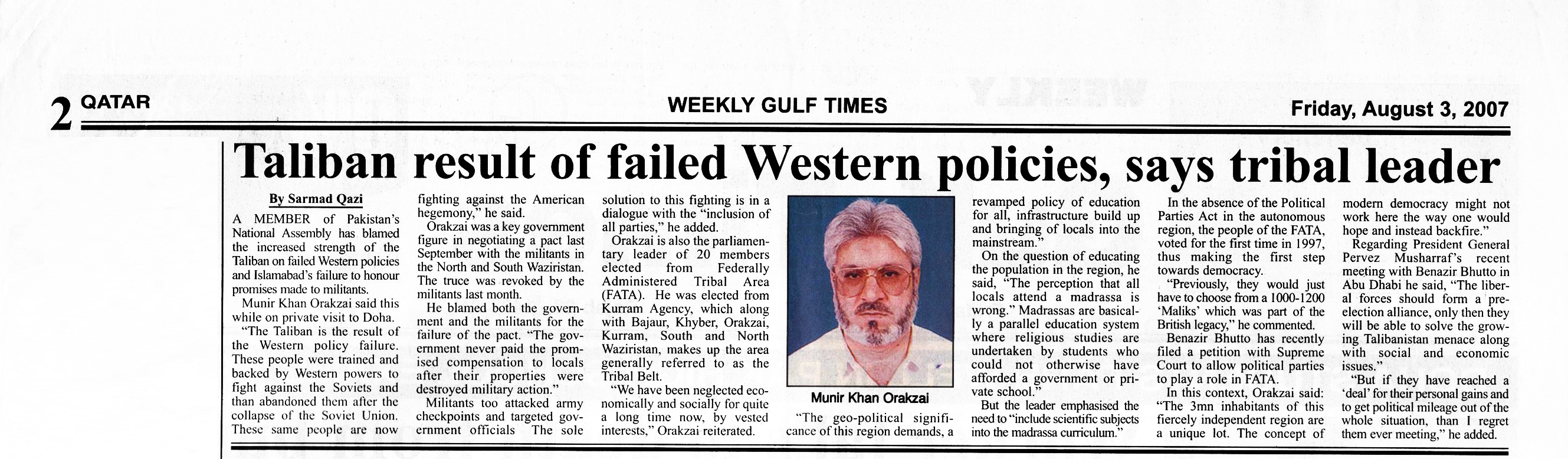
Taliban result of failed Western policies, says tribal leader
Originally published in Gulf Times on August 3, 2007
A MEMBER of Pakistan’s National Assembly has blamed the increased strength of the Taliban on failed Western policies and Islamabad’s failure to honour promises made to militants.
Munir Khan Orakzai said this while on a private visit to Doha.
“The Taliban is the result of the Western policy failure. These people were trained and backed by Western powers to fight against the Soviets and then abandoned them after the collapse of the Soviet Union. These same people are now fighting against the American hegemony,” he said.
Orakzai was a key government figure in negotiating a pact last September with the militants in the North and South Waziristan. The truce was revoked by the militants last month.
He blamed both the government and the militants for the failure of the pact.
“The government never paid the promised compensation to locals after their properties were destroyed in military action.” Militants too attached army checkpoints and targeted government officials. “The sole solution to this fighting is in a dialogue with the inclusion of all parties,” he added.
Orakzai is also the parliamentary leader of 20 members elected from the Federally Administered Tribal Area (FATA). He was elected from Kurram Agency which, along with Bajaur, Khyber, Orakzai, South and North Waziristan, makes up the area generally referred to as the Tribal Belt.
“We have been neglected economically and socially for quite a long time now, by vested interests. The geopolitical significance of this region demands a revamped policy of education for all, infrastructure build-up, and bringing of locals into the mainstream,” he said.
On the question of educating the population in the region, he said: “The perception that all locals attend a madrassa is wrong. Madrassas are basically a parallel education system where religious studies are undertaken by students who could not otherwise have afforded a government or private school.”
But the leader emphasised the need to “include scientific subjects into the madrassa curriculum.”
In the absence of the Political Parties Act in the autonomous region, the people of FATA voted for the first time in 1997 thus making the first step towards democracy.
“Previously, they would just have to choose from a 1,000-1,200 ‘Maliks’, which was part of the British legacy,” he commented.
Benazir Bhutto has recently filed a petition with Supreme Court to allow political parties to play a role in FATA.
In this context, Orakzai said: “The 3million inhabitants of this fiercely independent region are a unique lot. The concept of modern democracy might not work here the way one would hope and instead backfire.”
Regarding General Pervez Musharraf’s recent meeting with Benazir Bhutto in Abu Dhabi he said: “The liberal forces should form a pre-election alliance. Only then they will be able to solve the growing Talibanisation menace along with social and economic issues.”
“But if they have reached a ‘deal’ for their personal gains and to get political mileage out of the whole situation than I regret them ever meeting,” he said.
As Published