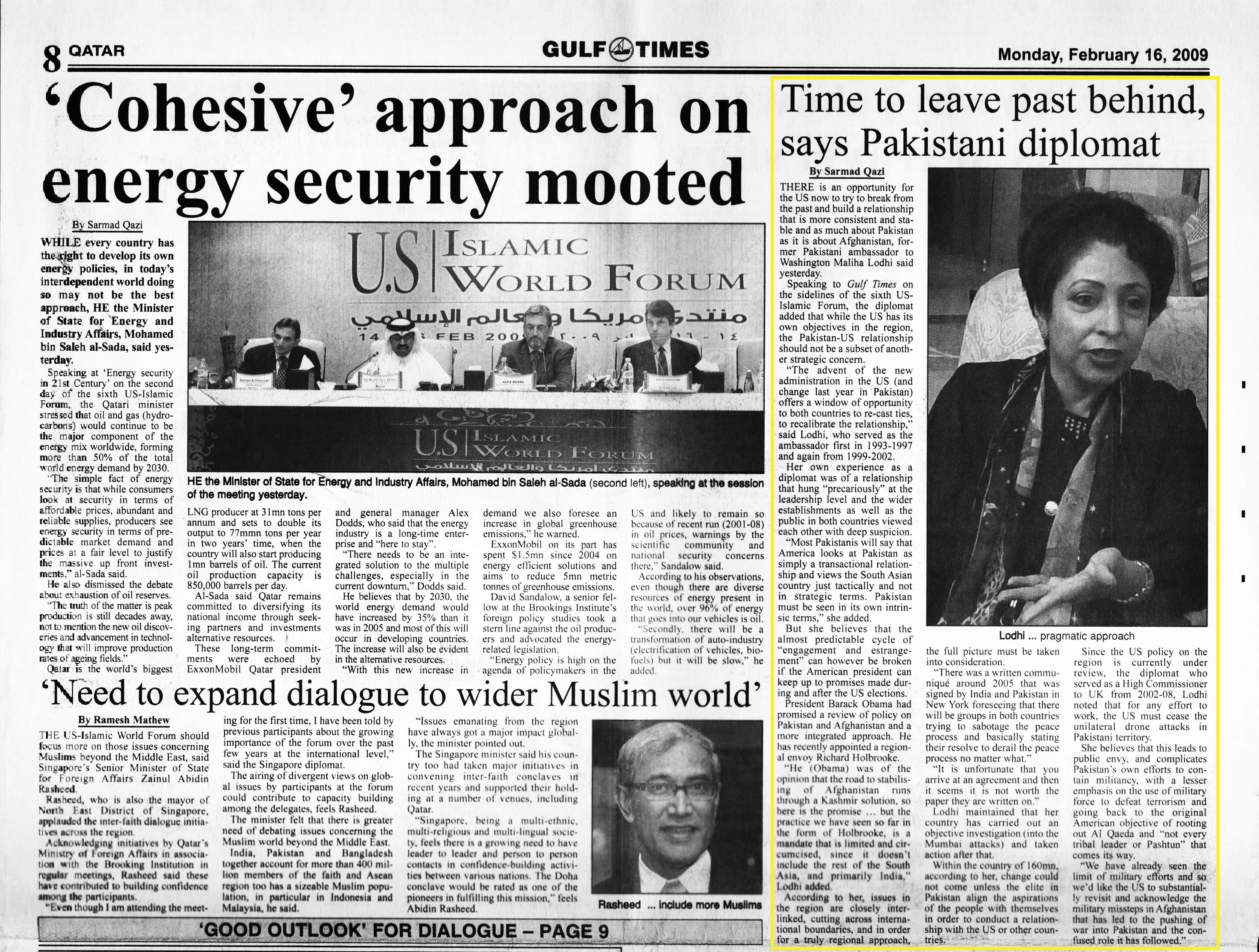
Time to leave past behind, says Pakistani diplomat
Originally published in Gulf Times on February 16, 2009
THERE is an opportunity for the US now to try to break from the past and build a relationship that is more consistent and stable and as much about Pakistan as it is about Afghanistan, former Pakistani ambassador to Washington Maliha Lodhi said yesterday.
Speaking to Gulf Times on the sidelines of the sixth US-Islamic Forum, the diplomat added that while the US has its own objectives in the region, the Pakistan-US relationship should not be a subset of another strategic concern.
“The advent of the new administration in the US (and change last year in Pakistan) offers a window of opportunity to both countries to re-cast ties, to recalibrate the relationship,” said Lodhi, who served as the ambassador first in 1993-1997 and again from 1999-2002.
Her own experience as a diplomat was of a relationship that hung “precariously” at the leadership level and the wider establishments as well as the public in both countries viewed each other with deep suspicion.
“Most Pakistanis will say that America looks at Pakistan as simply a transactional relationship and views the South Asian country just tactically and not in strategic terms. Pakistan must be seen in its own intrinsic terms,” she added.
But she believes that the almost predictable cycle of “engagement and estrangement” can however be broken if the American president can keep up to promises made during and after the US elections.
President Barack Obama had promised a review of policy on Pakistan and Afghanistan and a more integrated approach. He has recently appointed a regional envoy Richard Holbrooke.
“He (Obama) was of the opinion that the road to stabilising of Afghanistan runs through a Kashmir solution, so here is the promise … but the practice we have seen so far in the form of Holbrooke, is a mandate that is limited and circumcised, since it does not include the rest of the South Asia, and primarily India,” Lodhi added.
According to her, issues in the region are closely interlinked, cutting across international boundaries, and in order for a truly regional approach, the full picture must be taken into consideration.
“There was a written communique around 2005 that was signed by India and Pakistan in New York foreclosing that there will be groups in both countries trying to sabotage the peace process and basically stating their resolve to derail the peace process no matter what.”
“It is unfortunate that you arrive at an agreement and then it seems it is not worth the paper they are written on.”
Lodhi maintained that her country has carried out an objective investigation (into the Mumbai attacks) and taken action after that.
Within the country of 160mn, according to her, change could not come unless the elite in Pakistan align the aspirations of the people with themselves in order to conduct a relationship with the US or other countries.
Since the US policy on the region is currently under review, the diplomat who served as a High Commissioner to UK from 2002-08, Lodhi noted that for any effort to work, the US must cease the unilateral drone attacks in Pakistani territory.
She believes that this leads to public envy, and complicates Pakistan’s own efforts to contain militancy, with a lesser emphasis on the use of military force to defeat terrorism and going back to the original American objective of rooting out Al Qaeda and “not every tribal leader or Pashtun” that comes its way.
“We have already seen the limit of military efforts and so we’d like the US to substantially revisit and acknowledge the military missteps in Afghanistan that has led to the export of war into Pakistan and the confused role it has followed.”
As Published