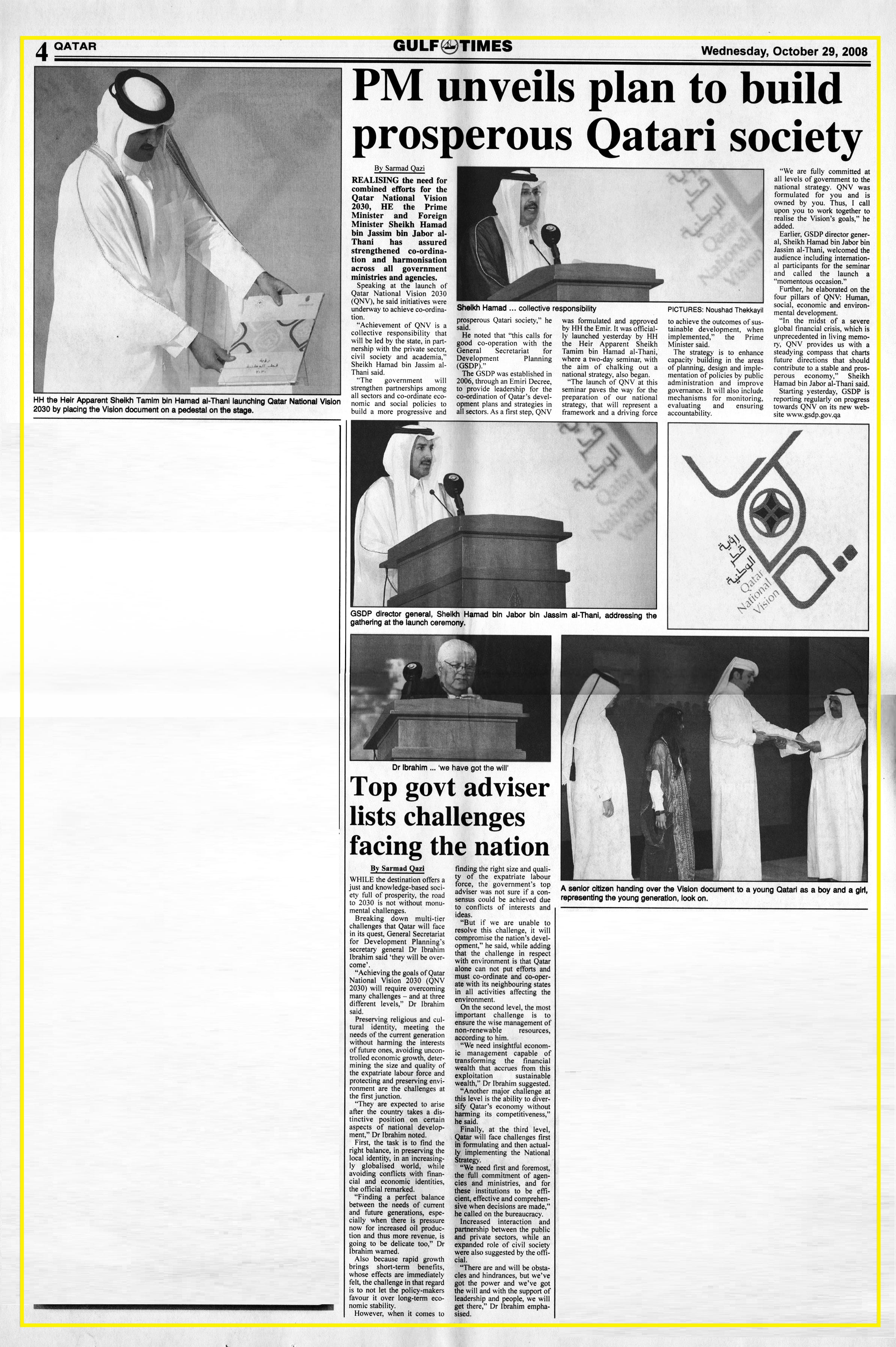
Top government adviser lists challenges facing the nation
Originally published in Gulf Times on October 29, 2008
WHILE the destination offers a just and knowledge-based society full of prosperity, the road to 2030 is not without monumental challenges.
Breaking down multi-tier challenges that Qatar will face in its quest, General Secretariat for Development Planning’s secretary general Dr Ibrahim Ibrahim said ‘they will be overcome’.
“Achieving the goals of Qatar National Vision 2030 (QNV 2030) will require overcoming many challenges - and at three different levels,” Dr Ibrahim said.
Preserving religious and cultural identity, meeting the needs of the current generation without harming the interests of future ones, avoiding uncontrolled economic growth, determining the size and quality of the expatriate labour force and protecting and preserving environment are the challenges at the first junction.
“They are expected to arise after the country takes a distinctive position on certain aspects of national development,” Dr Ibrahim noted.
First, the task is to find the right balance, in preserving the local identity, in an increasingly globalised world, while avoiding conflicts with financial and economic interests, the official remarked.
“Finding a perfect balance between the needs of current and future generations, especially when there is pressure now for increased oil production and thus more revenue, is going to be delicate too,” Dr Ibrahim warned.
Also because rapid growth brings short-term benefits, whose effects are immediately felt, the challenge in that regard is to not let the policy-makers favour it over long-term economic stability.
However, when it comes to finding the right size and quality of the expatriate labour force, the government’s top adviser was not sure if a consensus could be achieved due to conflicts of interests and ideas.
“But if we are unable to resolve this challenge, it will compromise the nation’s development,” he said, while adding that the challenge in respect with environment is that Qatar alone can not put efforts and must co-ordinate and co-operate with its neighbouring states in all activities affecting the environment.
On the second level, the most important challenge is to ensure the wise management of non-renewable resources, according to him.
“We need insightful economic management capable of transforming the financial wealth that accrues from this exploitation into sustainable wealth,” Dr Ibrahim suggested.
“Another major challenge at this level is the ability to diversify Qatar’s economy without harming its competitiveness,” he said.
Finally, at the third level, Qatar will face challenges first in formulating and then actually implementing the National Strategy.
“We need first and foremost, the full commitment of agencies and ministries, and for these institutions to be efficient, effective and comprehensive when decisions are made,” he called on the bureaucracy.
Increased interaction and partnership between the public and private sectors, while an expanded role of civil society were also suggested by the official.
“There are and will be obstacles and hindrances, but we’ve got the power and we’ve got the will and with the support of leadership and people, we will get there,” Dr Ibrahim emphasised.
As Published