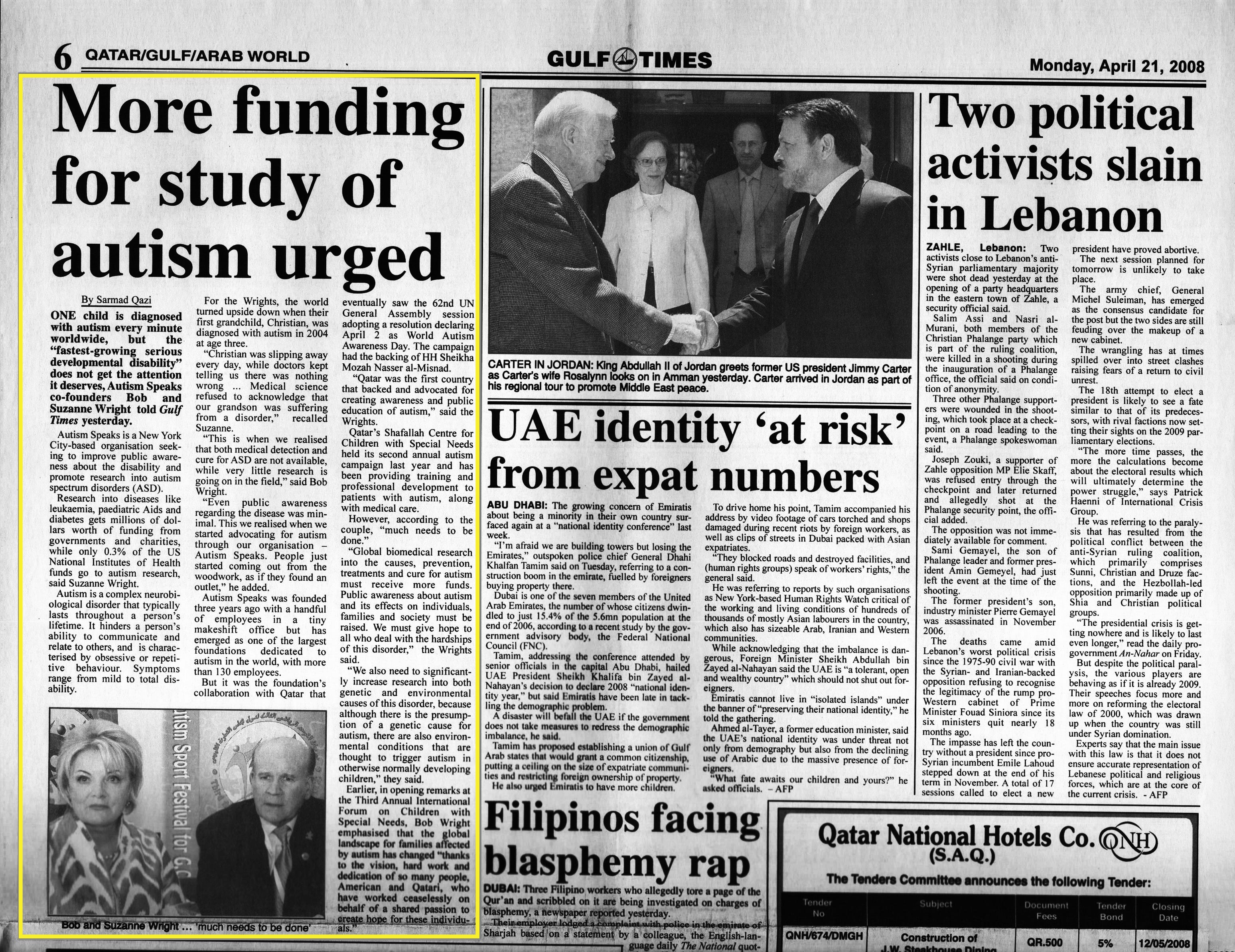
More funding for study of autism urged
Originally published in Gulf Times on April 21, 2008
ONE child is diagnosed with autism every minute worldwide, but the “fastest-growing serious developmental disability” does not get the attention it deserves, Autism Speaks co-founders Bob and Suzanne Wright told Gulf Times yesterday.
Autism Speaks is a New York City-based organisation seeking to improve public awareness about the disability and promote research into autism spectrum disorders (ASD).
Research into diseases like leukaemia, paediatric AIDs and diabetes gets millions of dollars worth of funding from governments and charities, while only 0.3% of the US National Institutes of Health funds go to autism research, said Suzanne Wright.
Autism is a complex neurobiological disorder that typically lasts throughout a person’s lifetime. It hinders a person’s ability to communicate and relate to others, and is characterised by obsessive or repetitive behaviour. Symptoms range from mild to total disability.
For the Wrights, the world turned upside down when their first grandchild, Christian, was diagnosed with autism in 2004 at age three.
“Christian was slipping away every day, while doctors kept telling us there was nothing wrong … Medical science refused to acknowledge that our grandson was suffering from a disorder,” recalled Suzanne.
“This is when we realised that both medical detection and cure for ASD are not available, while very little research is going on in the field,” said Bob Wright.
“Even public awareness regarding the disease was minimal. This we realised when we started advocating for autism through our organisation – Autism Speaks. People just started coming out from the woodwork, as if they found an outlet,” he added.
Autism Speaks was founded three years ago with a handful of employees in a tiny makeshift office but has emerged as one of the largest foundations dedicated to autism in the world, with more than 130 employees.
But it was the foundation’s collaboration with Qatar that eventually saw the 62nd UN General Assembly session adopting a resolution declaring April 2 as World Autism Awareness Day. The campaign had the backing of HH Sheikha Mozah Nasser al-Misnad.
“Qatar was the first country that backed and advocated for creating awareness and public education of autism,” said the Wrights.
Qatar’s Shafallah Centre for Children with Special Needs held its second annual autism campaign last year and has been providing training and professional development to patients with autism, along with medical care.
However, according to the couple, “much needs to be done.”
“Global biomedical research into the causes, prevention, treatments and cure for autism must receive more funds. Public awareness about autism and its effects on individuals, families and society must be raised. We must give hope to all who deal with the hardships of this disorder,” the Wrights said.
“We also need to significantly increase research into both genetic and environmental causes of this disorder, because although there is the presumption of a genetic cause for autism, there are also environmental conditions that are thought to trigger autism in otherwise normally developing children,” they said.
Earlier, in opening remarks at the Third Annual International Forum on Children with Special Needs, Bob Wright emphasised that the global landscape for families affected by autism has changed “thanks to the vision, hard work and dedication of so many people, American and Qatari, who have worked ceaselessly on behalf of a shared passion to create hope for these individuals.”
As Published