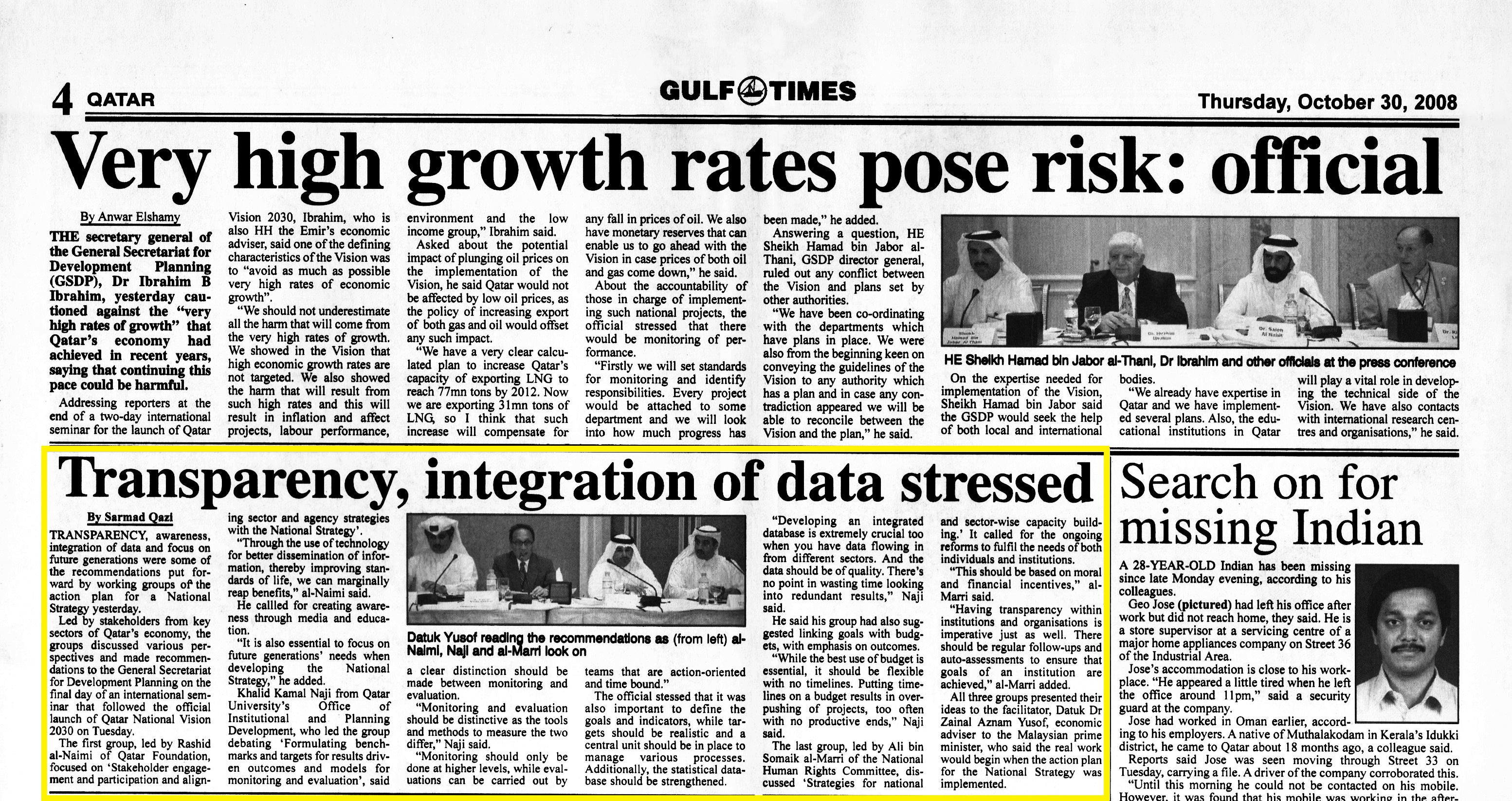
Transparency, integration of data stressed
Originally published in Gulf Times on October 30, 2008
TRANSPARENCY, awareness, integration of data and focus on future generations were some of the recommendations put forward by working groups of the action plan for a National Strategy yesterday.
Led by stakeholders from key sectors of Qatar’s economy, the groups discussed various perspectives and made recommendations to the General Secretariat for Development Planning on the final day of an international seminar that followed the official launch of Qatar National Vision 2030 on Tuesday.
The first group, led by Rashid al-Naimi of Qatar Foundation, focused on ‘Stakeholder engagement and participation and aligning sector and agency strategies with the National Strategy.’
“Through the use of technology for better dissemination of information, thereby improving standards of life, we can marginally reap benefits,” al-Naimi said.
He called for creating awareness through media and education.
“It is also essential to focus on future generations’ needs when developing the National Strategy,” he added.
Khalid Kamal Naji from Qatar University’s Office of Institutional and Planning Development, who led the group debating ‘Formulating benchmarks and targets for results-driven outcomes and models for monitoring evaluation,’ said a clear distinction should be made between monitoring and evaluation.
“Monitoring and evaluation should be distinctive as the tools and methods to measure the two differ,” Naji said.
“Monitoring should only be done at higher levels, while evaluations can be carried out by teams that are action-oriented and time bound.”
The official stressed that it was also important to define the goals and indicators, while targets should be realistic and a central unit should be in place to manage various processes. Additionally, the statistical database should be strengthened.
“Developing an integrated database is extremely crucial too when you have data flowing in from different sectors. And the data should be of quality. There’s no point in wasting time looking into redundant results,” Naji said.
He said his group had also suggested linking goals with budgets, with emphasis on outcomes.
“While the best use of budget is essential, it should be flexible with no timelines. Putting timelines on a budget results in over-pushing of projects, too often with no productive ends,” Naji said.
The last group, led by Ali bin Somaik al-Marri of the National Human Rights Committee, discussed ‘Strategies for national and sector-wise capacity building.’ It called for the ongoing reforms to fulfil the needs of both individuals and institutions.
“This should be based on moral and financial incentives,” al-Marri said.
“Having transparency within institutions and organisations is imperative just as well. There should be regular follow-ups and auto-assessments to ensure that goals of an institution are achieved,” al-Marri added.
All three groups presented their ideas to the facilitator, Datuk Dr Zainal Azman Yusof, economic adviser to the Malaysian prime minister, who said the real work would begin when the action plan for the National Strategy was implemented.
As Published